Early in A Moveable Feast, the memoir of his Paris years published after his death in 1964, Ernest Hemingway finishes a short story in a warm café on the Place Saint-Michel. He is drained, a little sad, and hungry. He orders "a dozen portugaises and a half-carafe of the dry white wine".1 Then he describes eating them: the strong taste of the sea, a faint metallic note that the cold wine rinses away, the liquor drunk from each shell. By the end of the plate the empty feeling has gone and he is making plans.
It is an often-quoted oyster scene, and most people who quote it pass over the word portugaises. The oyster Hemingway was eating in the Paris of the 1920s no longer exists in France. Within fifty years of that meal it had been wiped out.
What a Portugaise Was
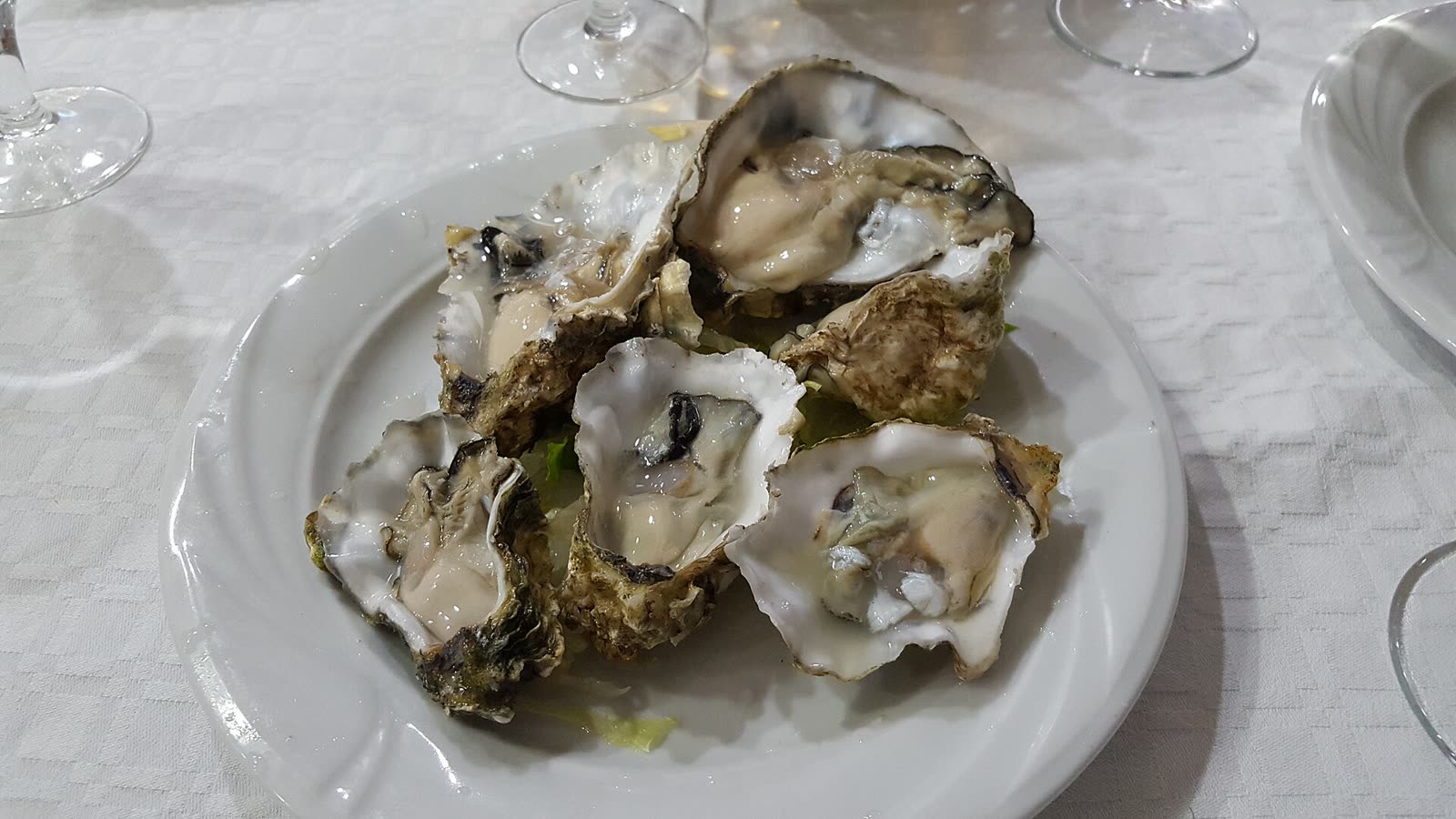
A portugaise was Crassostrea angulata, the Portuguese cupped oyster. Despite the name, it is probably not native to Portugal at all. Genetic work shows it is the common cupped oyster of Taiwan, and it is thought to have reached Portugal on ships in the sixteenth century.23 From there it spread along the Atlantic coast of Europe. By the twentieth century it had become the mainstay of French cupped-oyster farming.4
So when a young writer who was often short of money ordered a dozen in a café, the portugaise is what he got.

How It Disappeared
From 1966, Portuguese oysters on France's Atlantic coast began to die of a viral "gill disease" that eroded their gills, and mass die-offs recurred along the French coast for years.56 Then, between 1970 and 1973, a second virus, which infects the oyster's blood cells, struck the survivors. That wave finished the job. The Portuguese oyster disappeared from the French coast.5
France's oyster industry had to change species or collapse. From 1971 to 1975 it imported Pacific oysters, Crassostrea gigas: breeding adults from British Columbia and young spat from Japan. They grew well and began reproducing naturally on the French Atlantic coast.4 Almost every cupped oyster eaten in France today, including the famous Marennes-Oléron and Gillardeau oysters, descends from that rescue.
Where the Portugaise Survives
The Portuguese oyster did not vanish everywhere. In Portugal's Sado estuary, near Setúbal, wild beds of Crassostrea angulata survive and are treated as Europe's reference population for the species. A 2021 genetic study found that the natural beds there still hold high genetic diversity despite past bottlenecks. It also found Pacific oysters turning up in local hatcheries, and warned that the Sado population needs protecting.3
The Portuguese and Pacific oysters are close relatives, close enough that scientists have argued over whether they are separate species at all. So the oyster on a Paris plate today is a close cousin of the one Hemingway ate, one that came the long way around, by Canada and Japan, to fill the gap a virus left.
Reading the Scene Again
Knowing this changes the passage a little. Hemingway's oysters stand for comfort and renewal: the plain, cheap, reliable pleasure that restores a tired writer. That ordinary pleasure turned out to be fragile. When A Moveable Feast came out in 1964, French cafés were still serving portugaises. Within nine years, there were none left to serve.
The metallic note he describes is worth noticing too. It is often treated as a quirk of the European flat oyster, but here it is in a cupped oyster. That fits the science: much of the metallic sensation seems to come from fat-oxidation aroma compounds that every oyster makes, in larger or smaller amounts. The chemistry is explained in why some oysters taste metallic.
- Hemingway, E. (1964). A Moveable Feast. New York: Scribner. Publisher's sample text, Library of Congress: catdir.loc.gov
- Hsiao et al. (2016). DNA barcoding reveals that the common cupped oyster in Taiwan is the Portuguese oyster Crassostrea angulata (Ostreoida; Ostreidae), not C. gigas. Scientific Reports, 6, 34057. doi.org/10.1038/srep34057
- Chiesa et al. (2021). One in a million: genetic diversity and conservation of the reference Crassostrea angulata population in Europe from the Sado Estuary (Portugal). Life, 11(11), 1173. doi.org/10.3390/life11111173
- Grizel, H. & Héral, M. (1991). Introduction into France of the Japanese oyster (Crassostrea gigas). ICES Journal of Marine Science, 47(3), 399–403. doi.org/10.1093/icesjms/47.3.399
- Zannella et al. (2017). Microbial diseases of bivalve mollusks: infections, immunology and antimicrobial defense. Marine Drugs, 15(6), 182. doi.org/10.3390/md15060182
- Fisheries and Oceans Canada. "Gill Disease of Portuguese Oyster." dfo-mpo.gc.ca