In the seventeenth century, painters in Antwerp, Haarlem, Leiden and The Hague put oysters in their pictures again and again. They appear opened on pewter plates beside silver and glass, as empty shells on a tavern floor, and held out, with a knowing look, by a young woman at a table next to a curtained bed. In none of them is the oyster only food. Four paintings show the range, and the museums that hold them explain what their first viewers would have seen.
Luxury: Osias Beert, Antwerp, around 1620
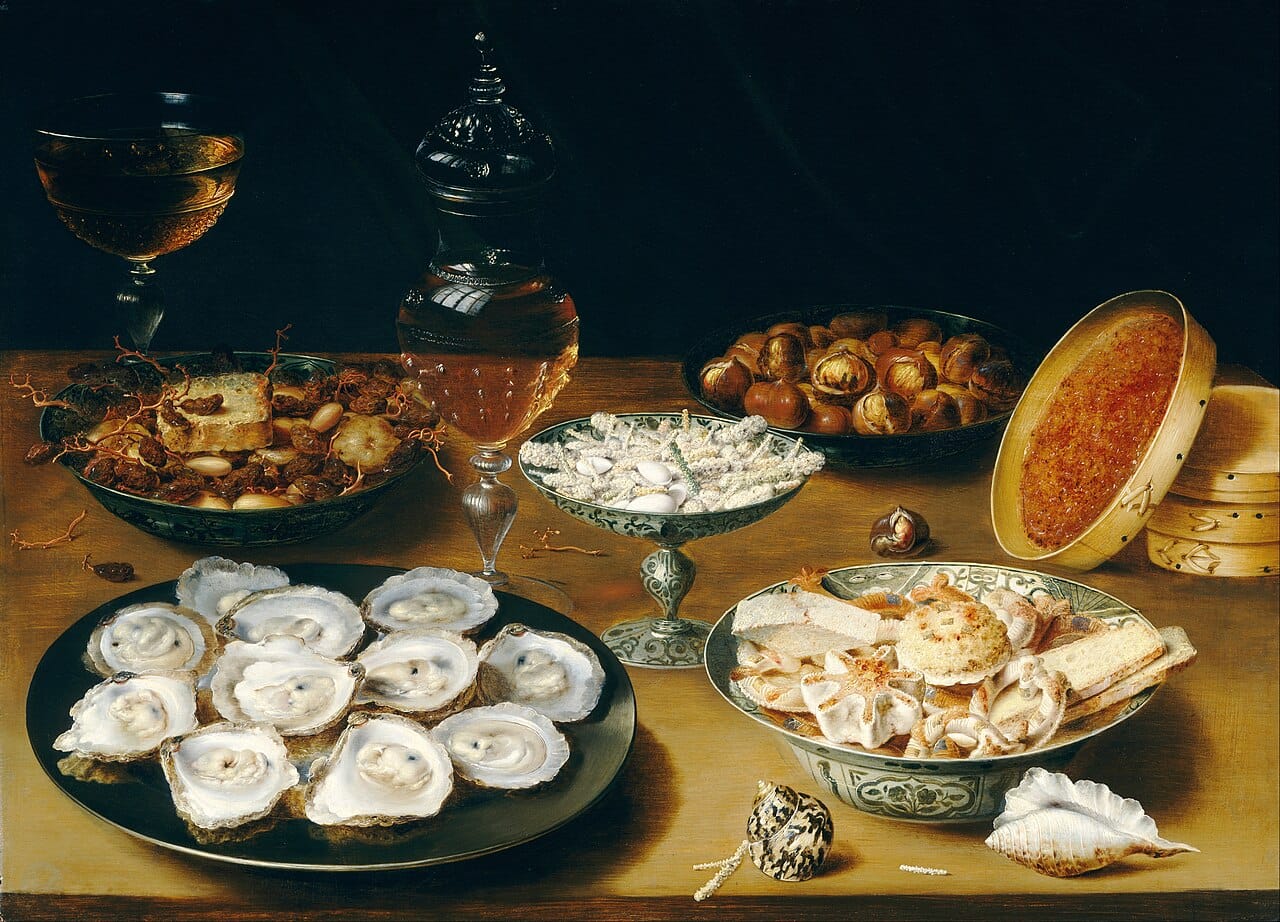
Osias Beert was probably the most important still-life painter in Antwerp in the early seventeenth century. In this painting, opened oysters sit on a pewter plate, painted so wet and soft that they look ready to slide off their shells. Around them are costly things: confections decorated with gold leaf in a Chinese Wan-Li porcelain bowl, dried fruit and almonds in Ming bowls, and two exotic shells. The National Gallery of Art describes the whole as a celebration of abundance, in which the shells emphasize the rarity of what is on the table.1 The oysters here stand for wealth and refinement. They are one of the expensive pleasures a rich Antwerp household could put on show. The gallery has a short video on how Beert styled the picture.
The Interrupted Meal: Willem Claesz. Heda, Haarlem, 1635
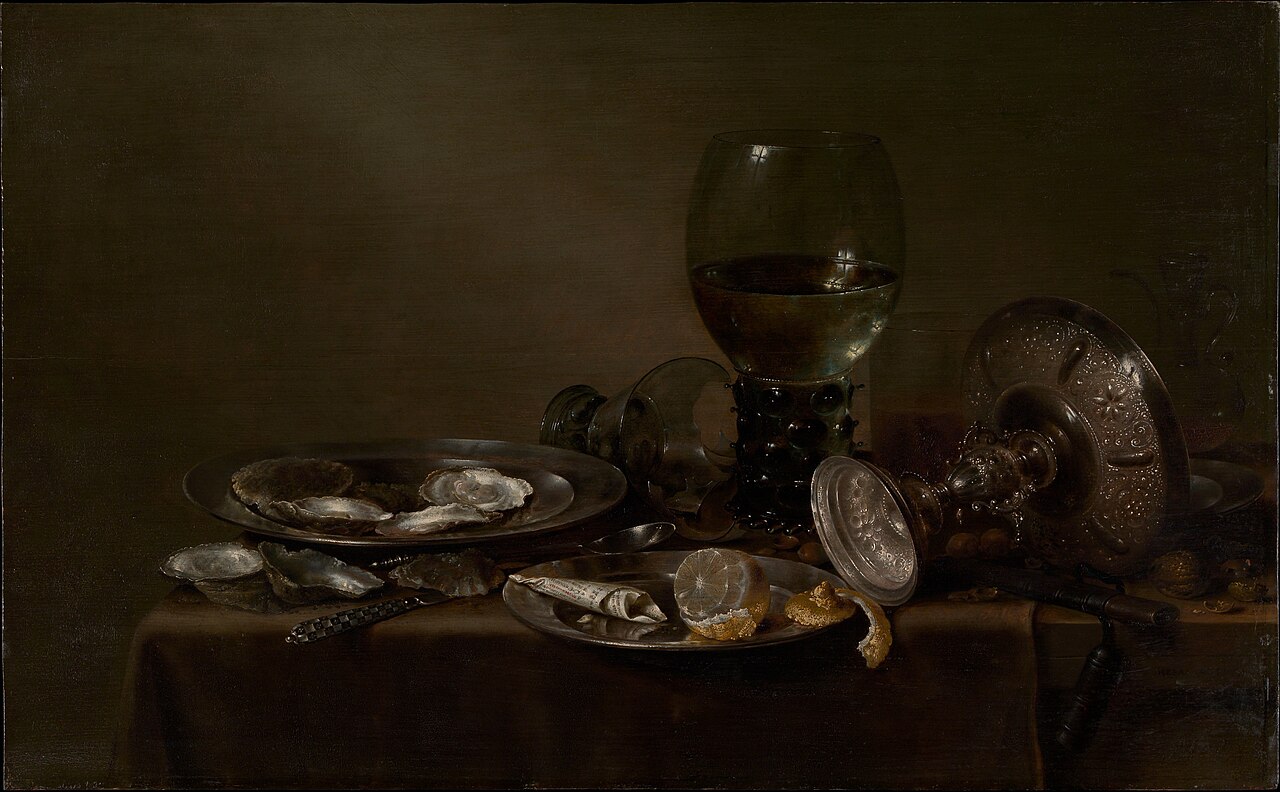
Fifteen years later in Haarlem, the mood is quieter. Heda's table holds two pewter plates of opened oysters, a tall green-stemmed glass half full of white wine, a silver tazza knocked on its side, a lemon with its peel spiraling off the plate and a spiral shell, all in a near-monochrome of grays, silvers and browns.2 Nobody is present, but the meal has plainly been interrupted: a cup has fallen, a lemon has been cut and left.
For a modern oyster eater, the painting is also a record of how oysters were served. They are opened on the flat shell, laid on pewter, eaten with lemon and white wine. That is close to how a good raw bar serves them today, nearly four centuries later.
Seduction: Jan Steen, about 1660
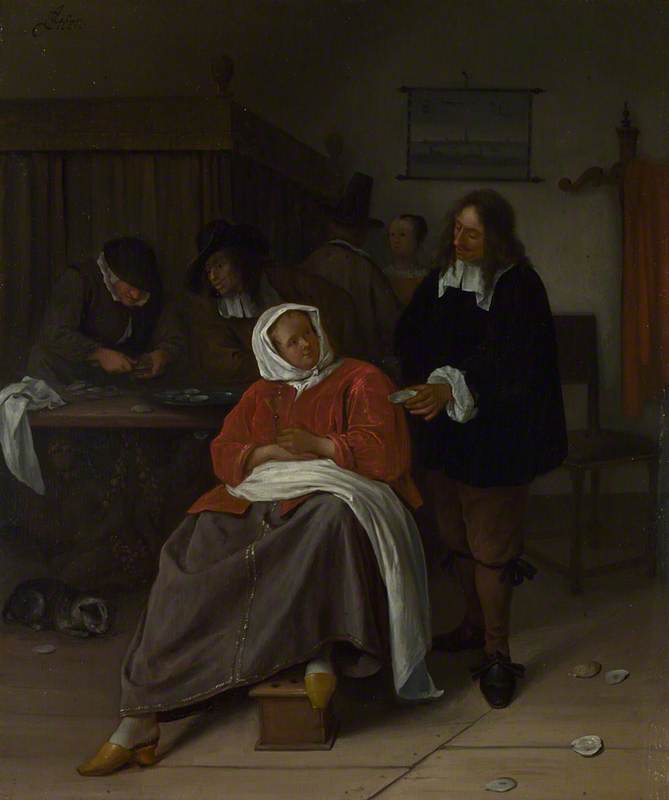
Jan Steen took oysters out of the dining room and into the tavern, where his audience knew what they meant. In this painting, a man in black holds out an opened oyster to a seated woman while, behind them, others open oysters at a table. Empty shells lie on the floor, and a curtained alcove hangs at the back of the room.
The Mauritshuis in The Hague owns another Steen on the same theme, Girl Eating Oysters, painted at the end of the 1650s, in which a young woman looks straight at the viewer while preparing an oyster. The museum spells out the meaning. Oysters had long been regarded as an aphrodisiac, and the girl is offering more than the oyster. The curtained bed in the background, one of only three pieces of furniture in the room, confirms the amorous point.3 The museum also quotes the physician Johan van Beverwijck, whose popular medical handbook of 1651 called oysters the most delicate of all shellfish, and claimed that the salt she sprinkles on them kindles desire.3
Seduction, Refined: Frans van Mieris, 1661
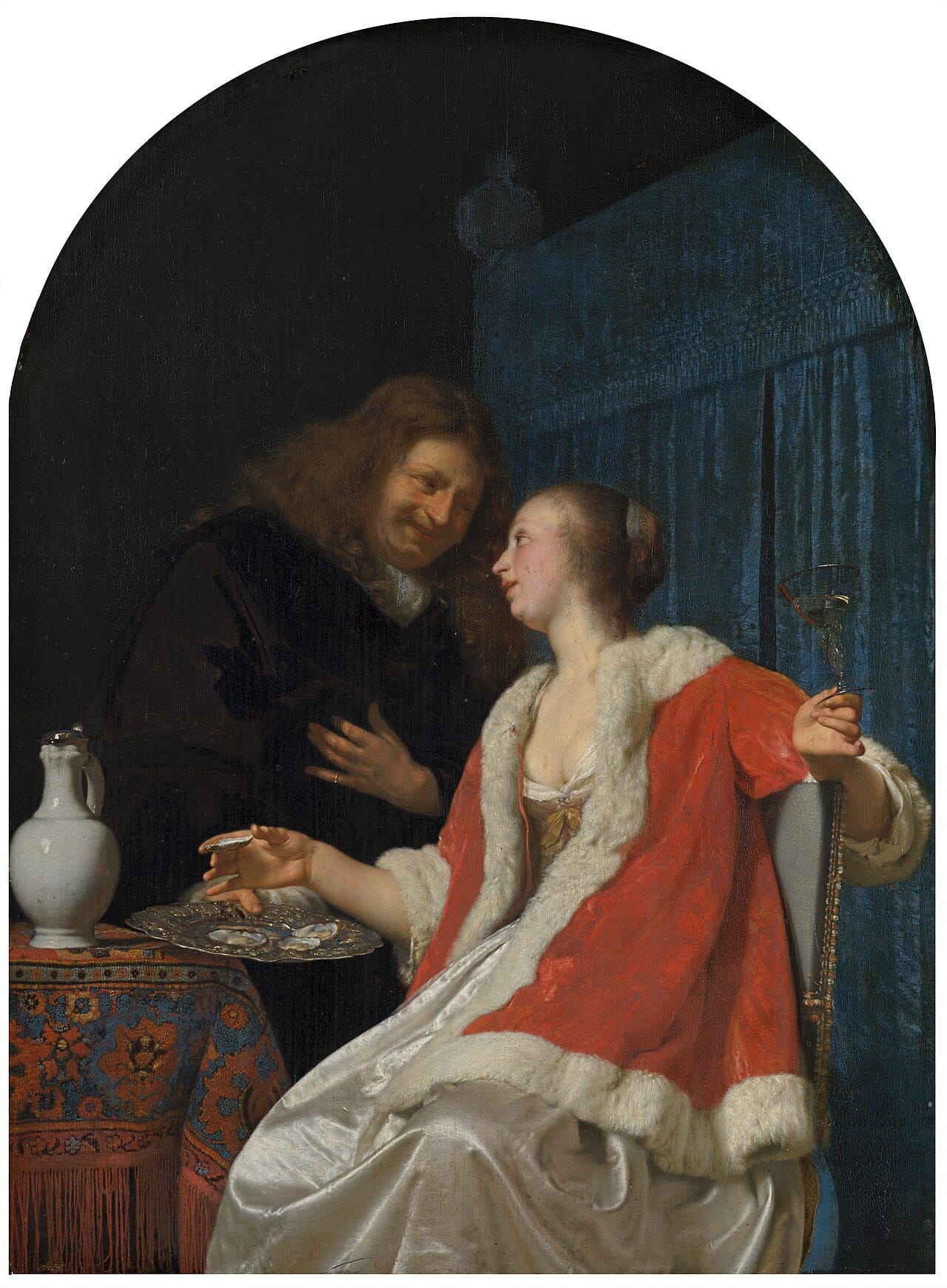
The Leiden painter Frans van Mieris gave the same idea a richer setting. A young woman in a fur-trimmed red jacket sits with a glass of wine in one hand and an oyster in the other, a silver dish of oysters beside her on a carpet-covered table. A man leans in close, smiling, one hand on his chest. Behind them, once again, hangs the blue curtain of a bed. Read with Steen's picture and the museum's explanation of it, nothing here needs decoding. The oyster, the wine and the bed tell the whole story.3
What the Paintings Tell Us
Together the four show how much one food carried. Beert's oysters sit among gold-leafed confections and Chinese porcelain as proof of wealth. Heda's give a painter wet, pearly, shifting surfaces to show off, and record a way of serving them, on the half shell with lemon and white wine, that a raw bar would recognize today. Steen and van Mieris paint them as a food of desire, and a physician had said as much in print.
That last idea never went away. It runs through Casanova's oyster suppers a century later and into every modern February feature about aphrodisiacs. The paintings are an early, vivid record of it, and all four are held in public collections in Washington, New York, London and The Hague. The oyster's move from the canvas to the gallery opening is told in the vernissage and the shell.
- National Gallery of Art, Washington. Osias Beert the Elder, Dishes with Oysters, Fruit, and Wine, c. 1620/1625. nga.gov
- The Metropolitan Museum of Art. Willem Claesz Heda, Still Life with Oysters, a Silver Tazza, and Glassware, 1635 (2005.331.4). metmuseum.org
- Mauritshuis, The Hague. Jan Steen, Girl Eating Oysters (inv. 818), collection entry. mauritshuis.nl