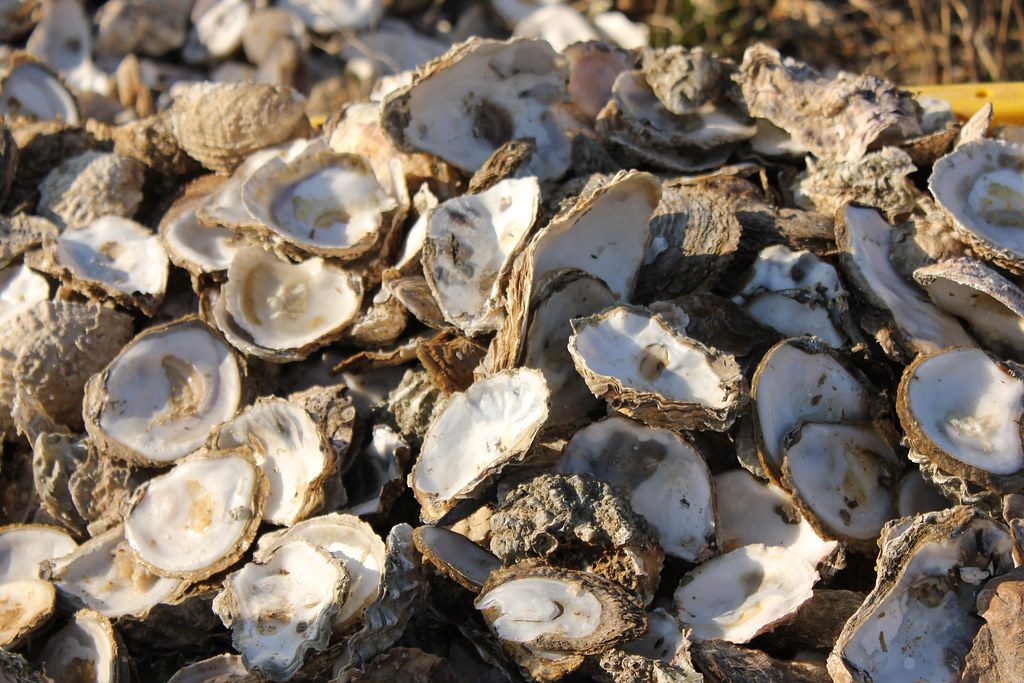
Once the oyster is eaten, the shell is almost always thrown away. Restaurants throw it out with the vegetable peelings. Processing plants pile it up by the coast, where it waits for a use that has never quite arrived. Most of a harvested oyster's weight is shell, so the industry leaves a great deal behind. In China, the world's largest producer, researchers describe millions of metric tons of shell dumped in landfill or along the shore every year.1
That shell is mostly calcium carbonate,2 the mineral of limestone, chalk and coral, and the raw material of cement. For centuries people have quarried calcium carbonate out of the ground to build with. An oyster makes its own out of seawater. The obvious question is whether the builders could use the oyster's version instead.
The Problem Shell Could Help With
Cement is one of the heaviest industrial sources of carbon dioxide. Making it means heating limestone to around 1,450°C, which burns fuel and also drives CO₂ out of the stone itself. That second source alone, the "process" emissions, came to about 1.5 billion metric tons of CO₂ in 2018, roughly 4% of the world's fossil-fuel emissions, before counting the fuel burned to reach those temperatures.3 The world made about 4.1 billion metric tons of cement in 2023.4
The industry already replaces part of its cement with other materials, such as fly ash from coal plants, slag from steelmaking and silica fume. Ground oyster shell has joined that list as a candidate. It is not the only one, but it comes with a disposal problem attached, so using it solves two problems at once.
What the Research Shows
A 2023 systematic review found the literature dominated by studies of shell in cement mortars and concrete, most of them from Asia. It found almost nothing from the Americas, Africa or Oceania, and little work on shell in finishing and bricklaying mortars.2 The findings so far follow a consistent shape. A little shell helps, and a lot hurts.
As a partial cement replacement, oyster shell powder works mainly as a fine filler. In one study, a blend of shell powder with lithium slag and blast-furnace slag replacing 10% of the cement slightly improved strength, and the gains faded by 30%. Shell powder used on its own made the weakest, most permeable concrete of the mixes tested.1 As a replacement for sand, crushed shell makes concrete weaker as the share rises, but not always too weak. In a 2024 study, concrete with 40% of its fine aggregate swapped for shell still reached 30 MPa, which meets common building-strength requirements, and it weighed about 10% less because shell is lighter than sand.5
The Carbon Accounting Question
It is tempting to call oyster shell stored carbon. It does contain carbon, fixed as calcium carbonate. The chemistry of making it points the other way, though. When a marine animal builds carbonate shell, the reaction releases carbon dioxide into the surrounding water, about 0.6 molecules of CO₂ for every unit of carbonate formed at the seawater conditions studied, and that ratio rises as the ocean takes up more CO₂.6 Shell-building, taken alone, is a small source of CO₂.
That changes how to read the construction case. Any climate benefit of shell in concrete comes from what the shell displaces, whatever the oyster did with carbon while it grew. Every metric ton of cement that is not made avoids the process and fuel emissions of making it. Every metric ton of sand that is not dug avoids damage to a river. Processing matters for the same reason. Grinding shell cold keeps it as carbonate and uses little energy. Calcining it releases the carbonate's CO₂ and burns fuel, which gives most of the advantage away.
The defensible claim is narrower and still worthwhile: used cold, oyster shell can replace some cement and some sand, and it takes a waste stream out of landfill and off the shoreline. Claims that the shells themselves are a carbon sink go further than the chemistry supports.
Sand Scarcity and the Coastal Opportunity
Sand is the other resource story. The world uses 40 to 50 billion metric tons of sand and gravel a year, according to the UN Environment Programme, the largest resource extracted by volume after water. Mining it from rivers and coasts has been linked to pollution, flooding, falling water tables and worsening drought.7
Set against that, oyster shell is a rounding error. It will never solve the sand problem globally. Locally, it can still matter. A shell heap outside a processing plant may sit a short drive from building sites that truck their sand in from far away. The obstacles are collection, cleaning and consistent supply.
Plate and Pillar
The shell on a plate in Paris or Tokyo is, in mineral terms, close to the limestone quarried for cement, which is why coastal builders have used both for as long as there have been coastal builders. What is new is the scale of modern oyster farming and the pressure on cement and sand. Treating the shell as a material makes sense. Just do the accounting on what the shell replaces, and leave out carbon it never stored.
- Liu, S., Zhang, Y., Liu, B., Zou, Z., Liu, Q., Teng, Y. & Zhang, L.V. (2022). Sustainable use of waste oyster shell powders in a ternary supplementary cementitious material system for green concrete. Materials, 15(14), 4886. doi.org/10.3390/ma15144886
- Bellei, P., Torres, I., Solstad, R. & Flores-Colen, I. (2023). Potential use of oyster shell waste in the composition of construction composites: a review. Buildings, 13(6), 1546. doi.org/10.3390/buildings13061546; see also Yoon, G.-L. et al. (2003). Chemical–mechanical characteristics of crushed oyster-shell. Waste Management, 23(9), 825–834. doi.org/10.1016/S0956-053X(02)00159-9
- Andrew, R.M. (2019). Global CO2 emissions from cement production, 1928–2018. Earth System Science Data, 11, 1675–1710. doi.org/10.5194/essd-11-1675-2019
- U.S. Geological Survey (2025). Mineral Commodity Summaries 2025: Cement (world production, 2023). pubs.usgs.gov
- Hong, Y.M. & Choudhury, S.R. (2024). The substitution effect of the fine aggregate in concrete with oyster shell. Materials, 17(24), 6148. doi.org/10.3390/ma17246148
- Frankignoulle, M., Canon, C. & Gattuso, J.-P. (1994). Marine calcification as a source of carbon dioxide: positive feedback of increasing atmospheric CO2. Limnology and Oceanography, 39(2), 458–462. doi.org/10.4319/lo.1994.39.2.0458
- UN Environment Programme (2019). Sand and Sustainability: Finding new solutions for environmental governance of global sand resources. wedocs.unep.org