In August 2009, engineers from the Edinburgh company Aquamarine Power set a 200-metric-ton buoyant steel flap on the seabed at Billia Croo, off the Atlantic coast of Orkney. It sat in about 12 meters of water, some 400 meters from shore, pinned to the rock by concrete piles driven 14 meters down. On November 20, 2009 Scotland's First Minister, Alex Salmond, officially launched the machine, which was called Oyster.1
For six years Oyster and its larger successor pumped wave energy ashore. The machine did its job. The company behind it did not survive. In November 2015 Aquamarine Power ceased trading, and its intellectual property passed to the public body Wave Energy Scotland.23
Where It Came From
The idea grew out of the Wave Power Research Centre at Queen's University Belfast, led by Professor Trevor Whittaker. Allan Thomson founded Aquamarine Power in 2005 to commercialize it, and the Scottish energy company SSE invested from 2007.2 Oyster belonged to a family of devices called oscillating wave surge converters. Most wave machines bob up and down in deep water. An oscillating surge converter stands on the seabed close to shore and rocks back and forth.
How It Worked
Close to shore, in 10 to 20 meters of water, waves move the water mostly horizontally, sloshing back and forth near the bottom rather than rolling in deep circles. Oyster was built to catch that surge. Its designers found that the usable energy at 10 meters is typically only 10–20% less than at 50 meters, while the nearshore waves arrive from a narrower range of directions and the largest storm waves have already broken before they reach the device.4 For a machine that has to survive Atlantic winters, that last point matters more than the lost energy.
The first unit had two parts. A 36-metric-ton steel frame was fixed to the seabed. Hinged to it was the power capture unit, a buoyant flap 18 meters tall, 12 meters wide and 4 meters deep, weighing 200 metric tons.1 As waves pushed the flap to and fro, it drove two hydraulic pistons. These pumped high-pressure water through a pipeline to a conventional hydroelectric turbine on land.3
That split was the design's central idea. Salt water destroys electrical equipment, so Aquamarine kept all the generation onshore where people could reach it. Only the flap, the hinge, the pistons and the pipe stayed in the sea, and with fewer parts underwater there was less to break in a place where repairs are slow and dangerous.
Why Orkney
Orkney sits at the northern tip of Scotland, exposed to the whole fetch of the North Atlantic, and its west coast takes some of the most energetic waves in Europe. That is why the European Marine Energy Centre was set up there, to test wave and tidal devices in real ocean conditions rather than in tanks. Oyster 800 sat at around 10 meters depth, roughly half a kilometer off Billia Croo, and Aquamarine reported spending more than £3 million in Orkney.3
Why the Company Failed Where the Machine Did Not
The trouble was money and timing. Through the early 2010s offshore wind costs fell quickly, and wind became the default answer to any question about marine renewables. A wave company had to show more than that its machine worked. It had to show a path from one 800 kW test unit to farms of many units at a price that could compete, and that path needed years of patient capital.
Aquamarine's next step was a 40 MW wave farm of Oyster units off north-west Lewis, which received full consent in May 2013. Infrastructure stalled it. The farm needed a new high-voltage cable to carry power from the island to the Scottish mainland, and in 2013 SSE announced it could not complete that link before 2017. Aquamarine called in administrators in October 2015, failed to find a buyer, and ceased trading in November with the loss of fourteen jobs.2
What Survived
What lasted was the knowledge. Wave Energy Scotland acquired Aquamarine's intellectual property and has published its lessons learned through a public knowledge-capture library, so the next developer does not have to relearn them.3 Years of measured performance in real North Atlantic water are rare in this industry. Tank tests and models can predict how a device should behave, but only the sea shows what actually happens to a large steel structure bolted to the bottom through six winters.
Oyster showed that a machine designed for the nearshore could survive Atlantic storms, send power to the grid, and keep its underwater parts few and robust. What remains open is who builds the next one, and whether the economics will have moved far enough to keep it running.
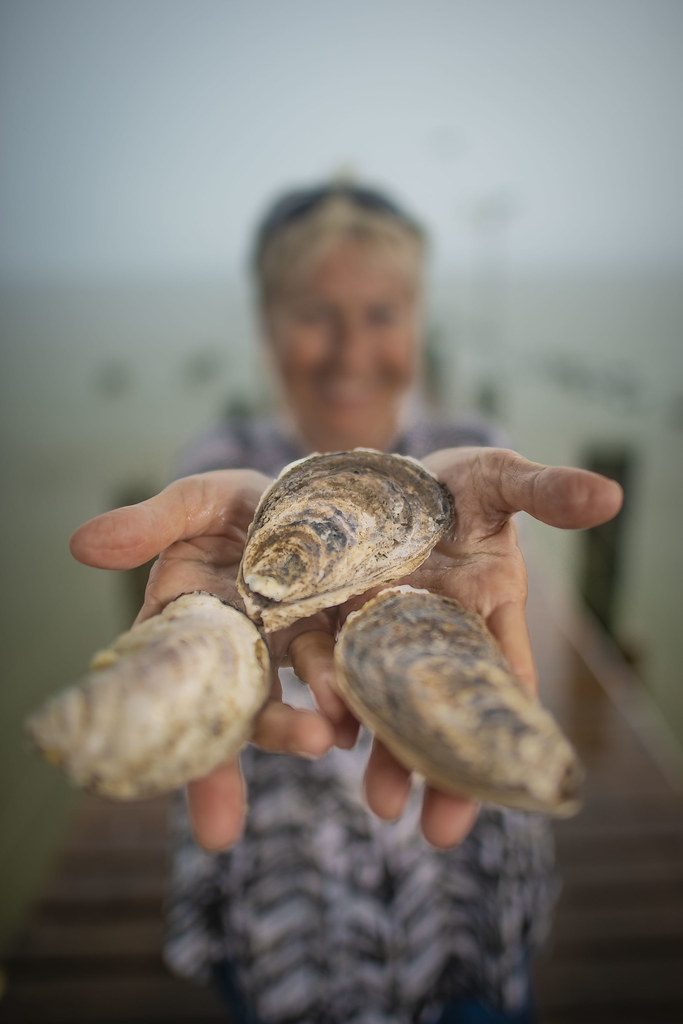
The name suits the machine. An oyster also lives fixed to the bottom in shallow, wave-beaten water.
- "Oyster wave energy converter." en.wikipedia.org (citing Aquamarine Power, Queen's University Belfast and BBC News)
- "Aquamarine Power." en.wikipedia.org (citing BBC News, October 28 and November 23, 2015)
- European Marine Energy Centre. "Aquamarine Power." emec.org.uk
- Whittaker, T. & Folley, M. (2012). Nearshore oscillating wave surge converters and the development of Oyster. Philosophical Transactions of the Royal Society A, 370(1959), 345–364. doi.org/10.1098/rsta.2011.0152