Order a dozen East Coast oysters and a dozen West Coast oysters in North America and you will taste two different ideas of an oyster. The Atlantic dozen tends to hit hard and early: salt, a firm bite, a mineral finish. The Pacific dozen tends to arrive rounder and sweeter, with cucumber or melon over the brine and a softer, fuller body. Salt and snap on one coast, sweetness and cream on the other.
The difference starts with the animal, and then with the energy of the water it grows in: how hard the tides move it, how cold it stays, how salty it is, and how much food it carries. Each of those shows up in the shell and on the palate.
First, It Is Usually Two Different Species
Most East Coast oysters are Eastern oysters, Crassostrea virginica, native from the Gulf of St. Lawrence to the Gulf of Mexico. Most West Coast oysters are Pacific oysters, Crassostrea gigas, brought from Japan in the twentieth century. The West also grows the Kumamoto (C. sikamea) and the native Olympia (Ostrea lurida). This is the single biggest cause of the difference. Two coasts with identical water would still produce different oysters.
The clearest chemical evidence is in aroma. A classic study of fresh Atlantic and Pacific oysters found the cucumber-smelling compounds (E,Z)-2,6-nonadienal and 3,6-nonadien-1-ol in Pacific oysters but not in Atlantic ones. Both species shared heavier, 'planty' eight-carbon compounds.1 That is why "cucumber" and "melon" belong to the West Coast vocabulary and rarely appear in descriptions of Eastern oysters.
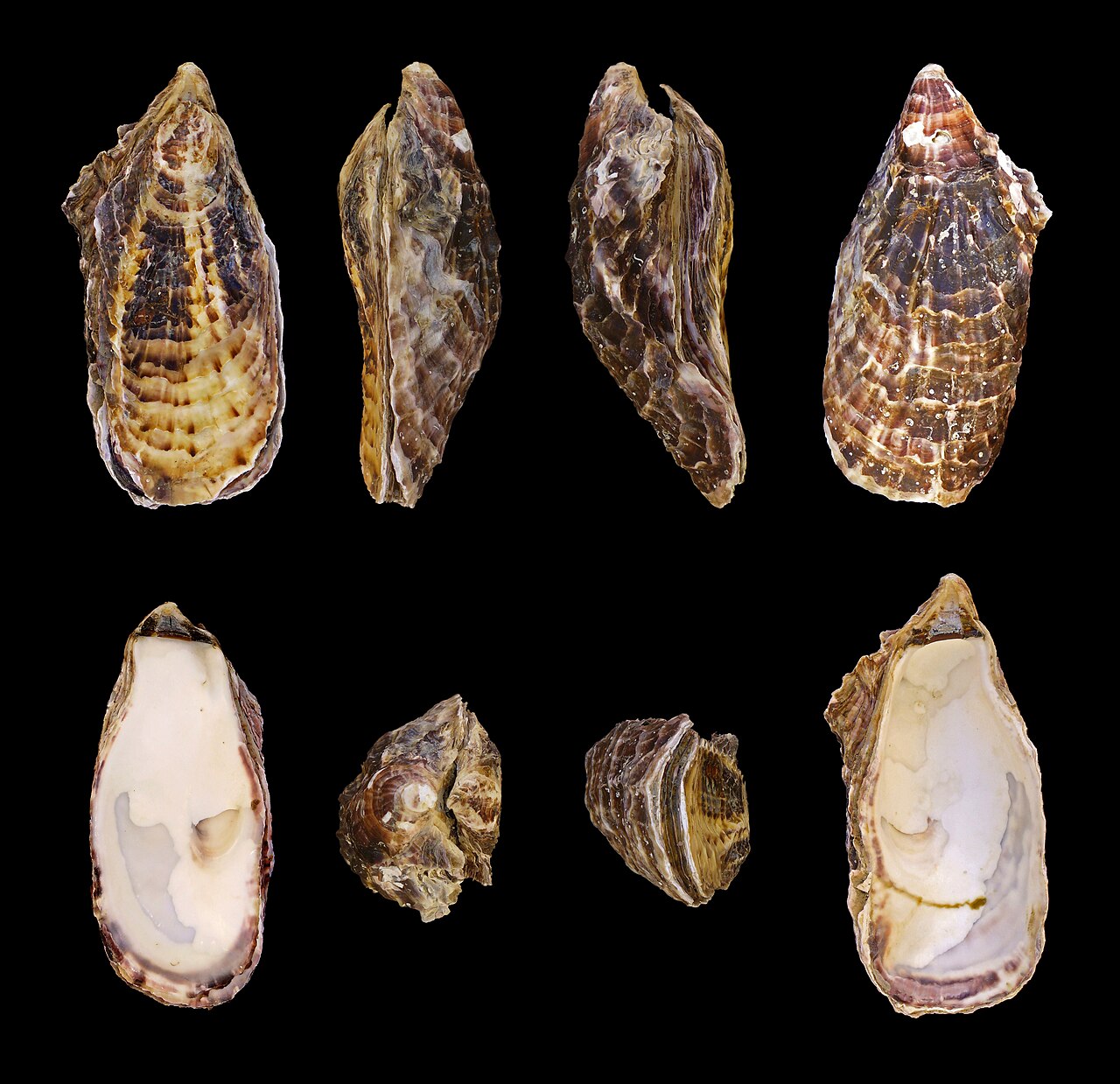
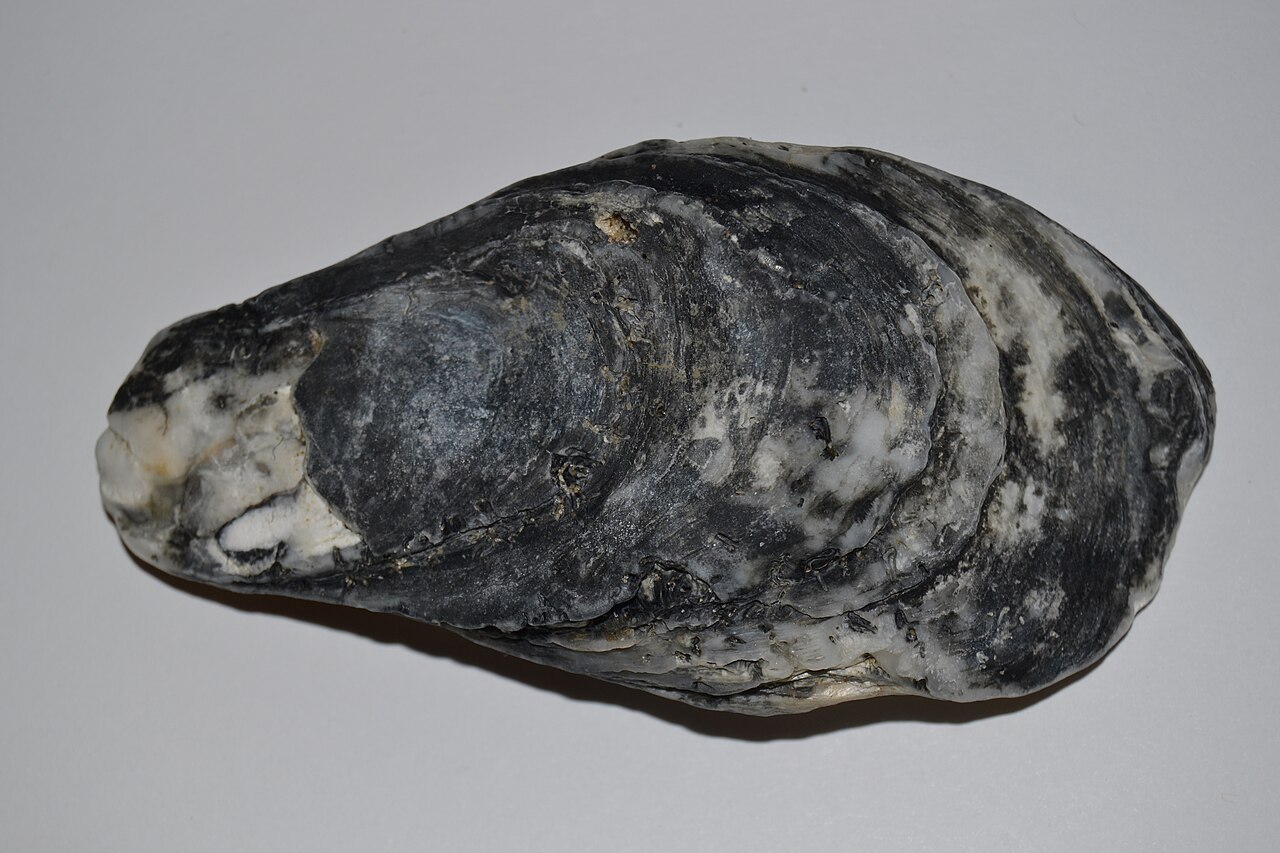
You can see the species before you taste it. Pacific shells tend to be long and deeply fluted, with thin, frilled growth edges that chip easily, the mark of a fast grower. Eastern shells are usually smoother, heavier and teardrop-shaped. Farming changes both. Tumbling and bag culture break off the frills and push shells toward a deeper cup on either coast.
Water Energy 1: Tides
Tides are the engine. Every tide moves water, and with it food, oxygen and fresh seawater, across an oyster bed. It is tempting to say the West Coast has big tides and the East small ones, but the numbers show something messier. Official NOAA figures for the average range between the higher high tide and the lower low tide each day give the real picture:2
So "East versus West" is really "open, tidal coast versus sheltered, low-tide bay". Puget Sound and the Gulf of Maine both see ranges of around three meters a day. The Chesapeake and the Gulf of Mexico see half a meter or less. On the East Coast, the oysters with the most "tension" tend to come from the energetic northern end, from Maine, Massachusetts and the Canadian Maritimes, where strong tides push full-strength seawater across the beds twice a day. The softer East Coast oysters come from the quiet, low-tide water of the Chesapeake and the Gulf.
Water Energy 2: Temperature
On the US West Coast, the prevailing winds of spring and summer drive coastal upwelling, pulling deep, cold, nutrient-rich water to the surface.45 That keeps Pacific Northwest water cool even in summer. On the East Coast, temperature splits north and south. The Gulf of Maine stays cold, while the Chesapeake and the Gulf of Mexico get very warm.
Temperature matters because warmth triggers spawning, and spawning spends the glycogen that gives an oyster its body and sweetness. The Pacific oyster generally spawns above 20 °C,6 and in southern waters Eastern oysters can spawn almost year-round while the water stays above 20 °C.7 Cold water gives an oyster more of the year to feed and store. That is a large part of where West Coast creaminess comes from, and it is why a cold-water Eastern oyster from Maine in winter can be as rich as anything from the Pacific. The winter case is made in why winter is the right season.
Water Energy 3: Salinity
Oysters match the salt of the water they grow in, and they balance that salt inside their cells with free amino acids such as glycine, alanine and glutamate, several of which taste sweet or savory.8 Full-strength seawater means a bigger salty hit and more of those molecules. Brackish water means less of both. In controlled trials on Pacific oysters, savory taste peaked at a salinity around 28–29‰, below full seawater.9
The East Coast has the wider range. Open-coast sites in Maine and on Cape Cod sit close to ocean salinity. The Chesapeake runs from fresh river water at the top to near-ocean salt at the mouth, so Chesapeake oysters range from gentle to fairly briny depending on where along that gradient they grew. Much of the West Coast's oyster water sits in sheltered bays and inlets such as Puget Sound, Hood Canal and Willapa Bay, where rivers take the edge off the ocean. That is one more reason the classic East Coast "brine bomb" is an open-Atlantic oyster.
Water Energy 4: Plankton
Upwelling fertilizes the water, and fertile water grows phytoplankton.4 Oysters build much of their aroma from the fatty acids in the algae they eat. Pacific oysters finished on different algal diets develop measurably different aroma compounds and sensory scores.10 Cold, upwelled water tends to favor diatoms rich in omega-3 fatty acids, the raw material for the cucumber compound. Combine that diet with a species that can make the compound, and the West Coast's green, fresh aroma follows. What the oyster ate traces the whole chain.
Putting It Together
The rule has exceptions, and they are the most fun part. A Maine Eastern oyster in January can be as creamy as any Pacific. A Pacific grown in warm, still water in August can taste thin. And some West Coast farms grow Eastern oysters, so the coast on the menu does not always tell you the species. The species and the water energy behind the name tell you far more.
- Josephson, D.B., Lindsay, R.C. & Stuiber, D.A. (1985). Volatile compounds characterizing the aroma of fresh Atlantic and Pacific oysters. Journal of Food Science, 50(1), 5–9. doi.org/10.1111/j.1365-2621.1985.tb13265.x
- NOAA Tides & Currents. Tidal datums (great diurnal range, 1983–2001 National Tidal Datum Epoch) for Seattle 9447130, Boston 8443970, Portland ME 8418150, Charleston OR 9432780, Baltimore 8574680 and Galveston Pier 21 8771450. tidesandcurrents.noaa.gov
- Tourism Nova Scotia. "8 Ways to Experience the Bay of Fundy." novascotia.com
- NOAA National Ocean Service. "What is upwelling?" oceanservice.noaa.gov
- Barton, A. et al. (2015). Impacts of coastal acidification on the Pacific Northwest shellfish industry and adaptation strategies implemented in response. Oceanography, 28(2), 146–159. doi.org/10.5670/oceanog.2015.38
- FAO. Cultured Aquatic Species Information Programme — Crassostrea gigas. fao.org
- NOAA Fisheries. Northeast Fisheries Climate Vulnerability Assessment — Eastern Oyster species narrative. st.nmfs.noaa.gov
- See the sources in Reading the number on the water.
- Bi et al. (2021). Investigating influence of aquaculture seawater with different salinities on non-volatile taste-active compounds in Pacific oyster (Crassostrea gigas). Journal of Food Measurement and Characterization, 15, 2078–2087. doi.org/10.1007/s11694-020-00807-4
- Pennarun, A.-L., Prost, C., Haure, J. & Demaimay, M. (2003). Comparison of two microalgal diets. 2. Influence on odorant composition and organoleptic qualities of raw oysters (Crassostrea gigas). Journal of Agricultural and Food Chemistry, 51(7), 2011–2018. doi.org/10.1021/jf020549c