The provenance on an oyster menu is a fair quality signal. Where an oyster grew, the water it grew in, how the farmer raised it and when it was harvested all shape what arrives on the plate. Provenance cannot promise consistency within a harvest, though. Two oysters lifted from the same cage on the same morning, raised for the same time in the same water, can be very different animals in flesh weight, in glycogen and in the amino acids behind flavor depth.
Research points to two drivers that are hard to see from outside. One is the environment each oyster experienced, such as its position in the bag and its access to food and current. The other is inherited differences in the metabolism that turns food into tissue, glycogen and the compounds we taste as sweetness and umami. The genetic part is now well documented. In a wild population of 144 Pacific oysters sampled at the same time, glycogen ranged from 2.1 to 10.4 mg/g, a more than fivefold spread, and it had nothing to do with shell size.1 Open a dozen and you are opening a dozen different animals.
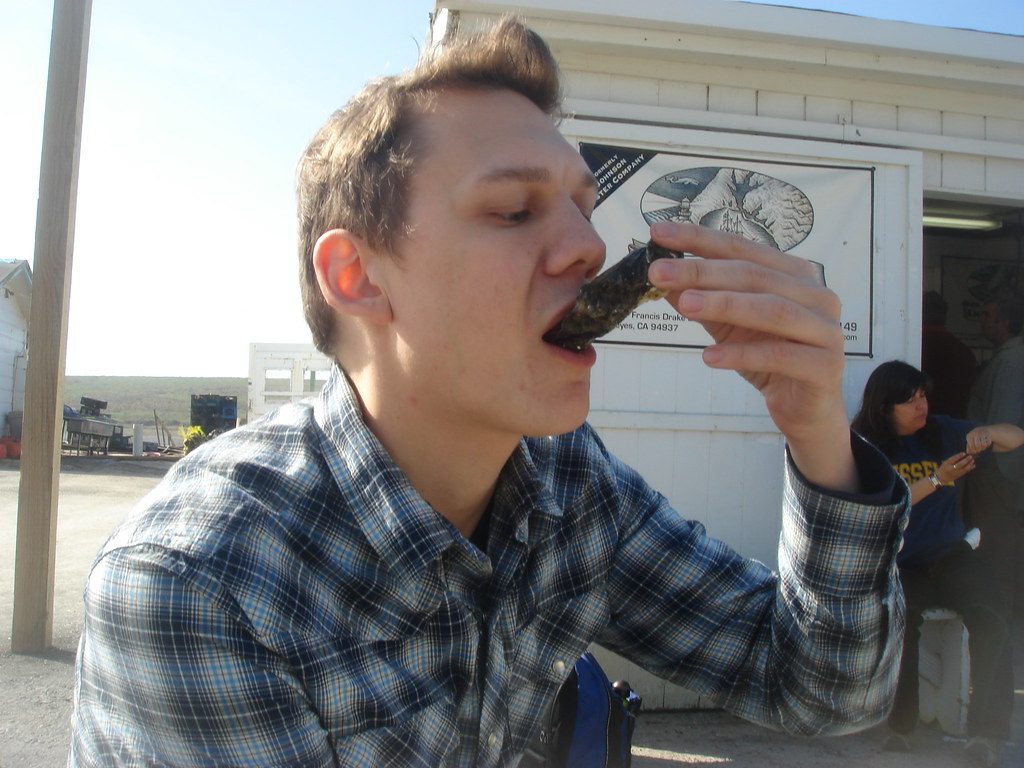
The Extent of Individual Variation
To separate genes from environment, researchers raise families of known parents in shared conditions and measure how much of the variation follows the family line. For glycogen, heritability estimates in Pacific oysters have come out at 0.292 and, in a selectively bred golden-shell line, 0.41.3 In animal breeding those are mid-range values, meaning the trait can be selected for but is far from fixed by genes. Genetics explains a meaningful share of why one oyster is richer than its neighbor, and environment and chance explain the rest.
At the extremes the gap is large. In a study that deliberately picked the richest and leanest oysters from one Pacific population, the high-glycogen group averaged 45% glycogen and the low group 26%.2 Size tells you little: in the wild population above, glycogen was unrelated to shell height, length or width.1 The best oyster in a given bag can be far richer than the worst one in the same bag, independent of season.
What Drives the Variation
The genetic differences act on how the oyster stores energy. Association studies have linked particular variants in glycogen-metabolism genes to higher or lower glycogen: a glycogen debranching enzyme, a glycogen phosphorylase and a regulator called PPP1R3B. The high-glycogen oysters also show matching differences in how strongly those genes are switched on.12 Some oysters are built to bank more of what they eat.
Growth and quality are partly independent traits, and can even pull against each other: in one breeding study, oysters with genes for taller shells tended toward less glycogen.3 Oyster breeding programs have historically selected for survival and growth; a line bred to grow fast is not automatically a line bred to be rich, and a farm that selects for growth alone is not necessarily selecting for eating quality.
The Gender Dimension
Oysters are not fixed in sex. The Pacific oyster is a sequential hermaphrodite, and a six-year French study that individually sexed thousands of oysters every year found sex change in both directions: among oysters followed for all six years, 58% changed sex at least once, some of them several times, while the population as a whole was female-biased every year.4 This matters for flavor because males and females at maturity are different foods. Comparing three Crassostrea species, researchers found that mature females had higher glycogen, lipid, copper and zinc than males, while males had more protein and taurine.5
A dozen oysters from a wild-type population harvested in the breeding season will almost certainly mix males and females, and that mix accounts for a good part of the variation on the plate. The fat, rich oyster and the leaner, sharper one beside it may simply be a female and a male from the same cage. That is the biology of an animal whose sexes differ and which changes sex, not a failure of quality control. Harvesting outside the breeding season, when gonads are small, narrows the gap.
What a Single Farm Actually Guarantees
Single-farm provenance still means something. It tells you about the water, the farming and the conditions that produced the oyster. It cannot tell you which oyster in the harvest will be exceptional and which ordinary. Season, genetics and sex decide that, and provenance labels capture none of them.
The producers who understand this usually talk about their oysters most precisely. They know their average meat index at different times of year and whether they are working with selected lines or unselected wild stock. They also know that selling "premium" oysters means selecting within the harvest rather than putting everything viable under one label. The gap between a well-chosen dozen and a random dozen from the same cage is bigger than most menus admit.
With heritability around 0.3 to 0.4,23 breeders could make progress on flavor in a few generations. The bottleneck is measurement: glycogen analysis requires a laboratory and usually kills the animal. Near-infrared spectroscopy is being developed as a rapid alternative for estimating oyster composition at the scale a breeding program needs.6
A Different Standard of Provenance
If measurement gets cheap enough, a menu could one day name an oyster's breeding line and its meat index at harvest, the way wine lists moved from region to single vineyard. That is some way off.
Until then, the practical advice is simpler. Buy from producers who know their oysters beyond geography and season. And value a shucker who checks every oyster before it reaches the plate, because that selection is a quality filter that no provenance claim can replace.
- She, Z., Li, L., Qi, H., Song, K., Que, H. & Zhang, G. (2015). Candidate gene polymorphisms and their association with glycogen content in the Pacific oyster Crassostrea gigas. PLoS ONE, 10(5), e0124401. doi.org/10.1371/journal.pone.0124401
- Liu, S. et al. (2019). Association and functional analyses revealed that PPP1R3B plays an important role in the regulation of glycogen content in the Pacific oyster Crassostrea gigas. Frontiers in Genetics, 10, 106. doi.org/10.3389/fgene.2019.00106
- Wan et al. (2020). Estimating heritability for meat composition traits in the golden shell strain of Pacific oyster (Crassostrea gigas). Aquaculture, 516, 734532. doi.org/10.1016/j.aquaculture.2019.734532
- Broquard, C., Martinez, A.-S., Maurouard, E., Lamy, J.-B. & Dégremont, L. (2020). Sex determination in the oyster Crassostrea gigas — a large longitudinal study of population sex ratios and individual sex changes. Aquaculture, 515, 734555. doi.org/10.1016/j.aquaculture.2019.734555
- Qin, Y. et al. (2023). Comparison of biochemical composition, nutritional quality, and metals concentrations between males and females of three different Crassostrea sp. Food Chemistry, 398, 133868. doi.org/10.1016/j.foodchem.2022.133868
- Wang, W.J. et al. (2015). Development of calibration models for rapid determination of chemical composition of Pacific oyster (Crassostrea gigas) by near infrared reflectance spectroscopy. Journal of Shellfish Research, 34(2), 303–309. doi.org/10.2983/035.034.0212