Basic Profile
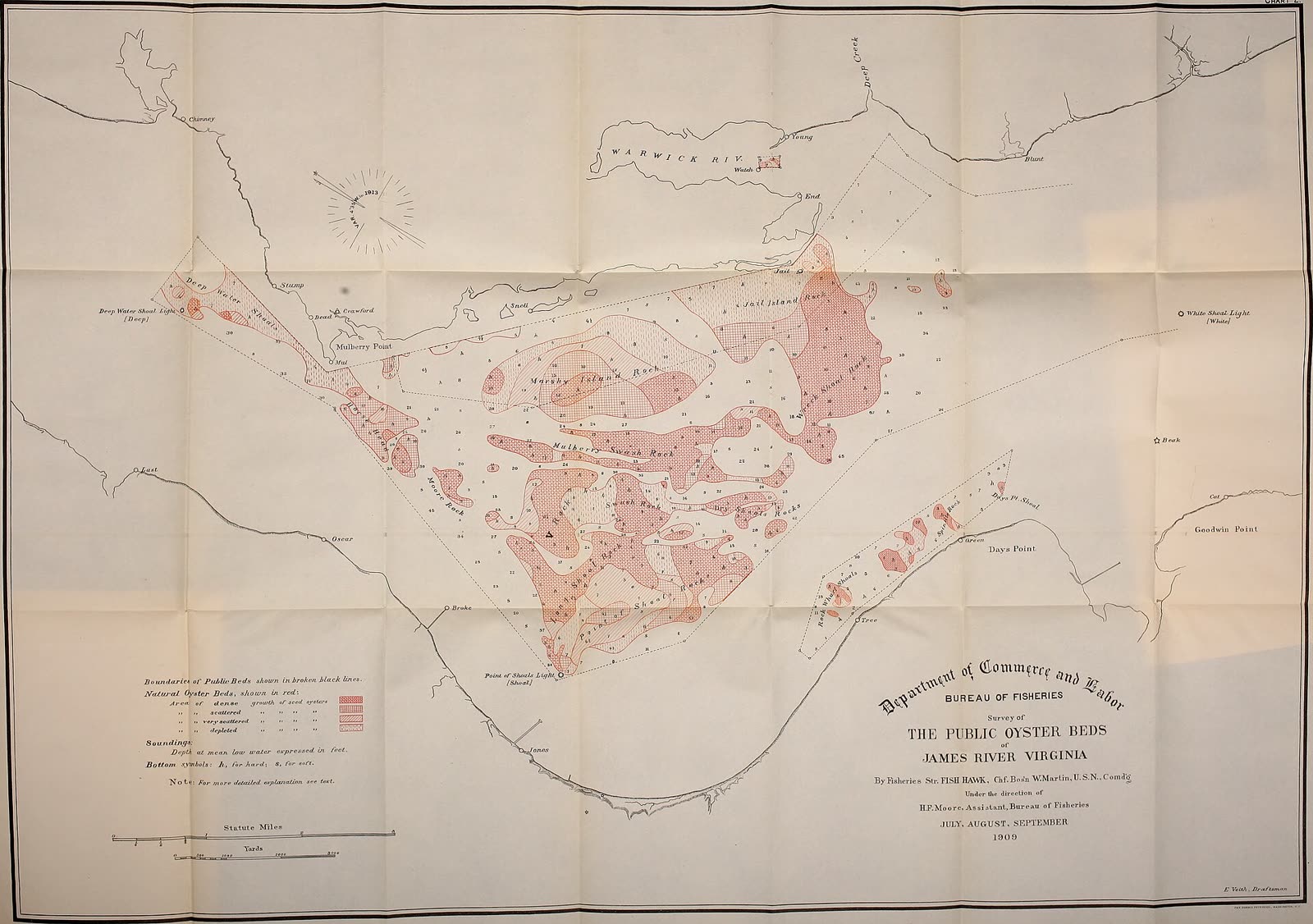
The James River has been an oyster river for as long as the English have been in Virginia, and for thousands of years before that. Shell heaps along its banks, like those described in what ancient shell middens reveal, mark those older meals. For generations it was also the state's nursery: watermen went miles upriver each autumn to buy small seed oysters, then planted them on their own grounds near Crittenden, where they grew for eighteen months or more before sale in Norfolk.1

What the Jamestown Well Revealed
In 2010, researchers from the Virginia Institute of Marine Science and two other universities analyzed 400-year-old oyster shells from an abandoned well at Jamestown. The chemistry of the shells showed that in 1611 the river near Jamestown averaged a winter salinity of about 16, against 3 to 10 in winter today, implying 40 to 50% less freshwater flow. The colonists had arrived in a severe drought, from 1606 to 1612, and the saltier water let oyster reefs extend more than 12 miles upriver toward the settlement, adding to the food available during the "Starving Time" of 1609–1610.23
A Low-Salt River
That comparison points to what defines the James today: it is a fresh, low-salinity river for much of its oyster range. Low salinity also protects oysters from the parasite MSX, which oysters expel in water at or below about 10 ppt.4 It also shapes flavor, as how salinity shapes flavor explains. The river's public oyster grounds have been growing again: the James River Association's 2020 State of the James report recorded a 25% expansion.1
Flavor Breakdown
What Makes James River Unique
The James is the oyster river of Virginia's colonial story. Shells from a 400-year-old Jamestown well show the river was far saltier in 1611, in a drought that let reefs reach 12 miles farther upriver and fed the colonists through the Starving Time.23 Today its low salt is an advantage: oysters expel the MSX parasite in water at or below about 10 ppt.4
Should You Add Lemon?
A lower-salt oyster welcomes a squeeze.
Pairing Guide
Local, aromatic whites for a sweet oyster.
Cold and easy.
| Optimal | Lemon |
| Acceptable | Mignonette |
| Avoid | Heavy cocktail sauce |
Who Is This For?
- Anyone who finds salty oysters too much
- Virginia history fans
- Salt hunters
- James River Association. "Taste of the James: Holiday Oysters." thejamesriver.org
- Harding, J.M., Spero, H.J., Mann, R., Herbert, G.S. & Sliko, J.L. (2010). Reconstructing early 17th century estuarine drought conditions from Jamestown oysters. Proceedings of the National Academy of Sciences, 107(23), 10549–10554. doi.org/10.1073/pnas.1001052107
- Virginia Institute of Marine Science (2010). "VIMS oyster study confirms early Jamestown drought." vims.edu
- Virginia Institute of Marine Science, Shellfish Pathology Laboratory. "MSX Fact Sheet." vims.edu