Basic Profile
Netarts Bay is a small estuary on Oregon's north coast, behind a sand spit that forms part of Cape Lookout State Park. It covers about 2,325 acres, two-thirds of it intertidal mudflat, and no river runs into it: its 13-square-mile watershed drains through at least 16 small creeks.1 That makes it a salty, ocean-dominated bay, and home to one of the most important oyster hatcheries on the West Coast.

The Hatchery That Sounded the Alarm
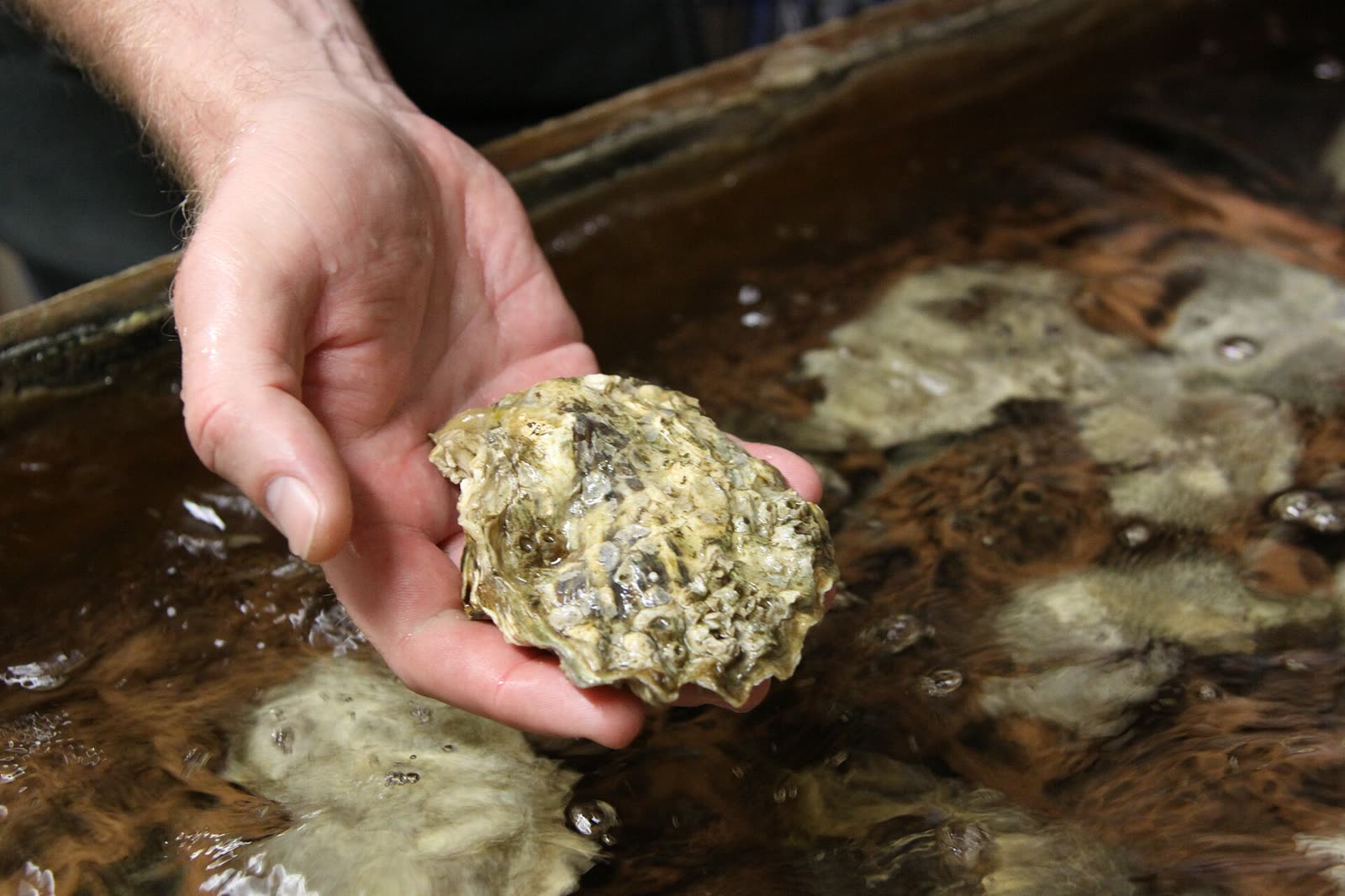
Whiskey Creek Shellfish Hatchery sits on Netarts Bay and is one of the largest suppliers of oyster seed on the West Coast. Between 2006 and 2008 it lost 70 to 80% of its larvae. The owners first suspected bacteria. Burke Hales, a biogeochemist at Oregon State University, found the real cause: the seawater drawn from the bay carried too much dissolved carbon dioxide.2
The research that followed, led by Alan Barton with Hales and colleagues, linked larval production at the hatchery to the carbonate chemistry of the water, which turns corrosive for young shells when deep, CO₂-rich water wells up onto the coast.3 The hatchery adapted by buffering its tank water with sodium bicarbonate and by drawing water later in the day, when phytoplankton have taken up some of the CO₂.2 Netarts Bay became the place where shellfish farmers first saw ocean acidification in their own tanks. What that means for oysters is covered in a more acidic ocean.
The Farms
Pacific oysters were first farmed commercially in the bay from 1930.1 Today several small farms grow them on the flats. Pearl Point Oyster Co., run by a family that began farming oysters in Willapa Bay in 1873, raises oysters from its own broodstock and from Whiskey Creek seed, and grows them on the Netarts mudflats for two to four years before harvest.4
Flavor Breakdown
What Makes Netarts Bay Unique
Netarts Bay is where oyster farmers first saw ocean acidification in their own tanks. The Whiskey Creek hatchery on its shore lost 70 to 80% of its larvae between 2006 and 2008, and researchers traced the cause to corrosive, CO₂-rich upwelled seawater.23 Seed from that hatchery still stocks farms up and down the coast, including the flats of Netarts itself.4
Should You Add Lemon?
A squeeze suits a salty oyster; try one plain first.
Pairing Guide
Local, with enough body for a firm oyster.
Lean and salty.
| Optimal | Mignonette |
| Acceptable | Lemon |
| Avoid | Heavy cocktail sauce |
Who Is This For?
- Anyone interested in ocean acidification and how farms adapt
- Visitors to Cape Lookout and Tillamook
- Anyone who wants a soft, low-salt oyster
- "Netarts Bay." en.wikipedia.org
- Grossman, E. (November 21, 2011). "Northwest Oyster Die-offs Show Ocean Acidification Has Arrived." Yale Environment 360. e360.yale.edu
- Barton, A., Hales, B., Waldbusser, G.G., Langdon, C. & Feely, R.A. (2012). The Pacific oyster, Crassostrea gigas, shows negative correlation to naturally elevated carbon dioxide levels: implications for near-term ocean acidification effects. Limnology and Oceanography, 57(3), 698–710. doi.org/10.4319/lo.2012.57.3.0698
- Pearl Point Oyster Co. "About." pearlpointoyster.com