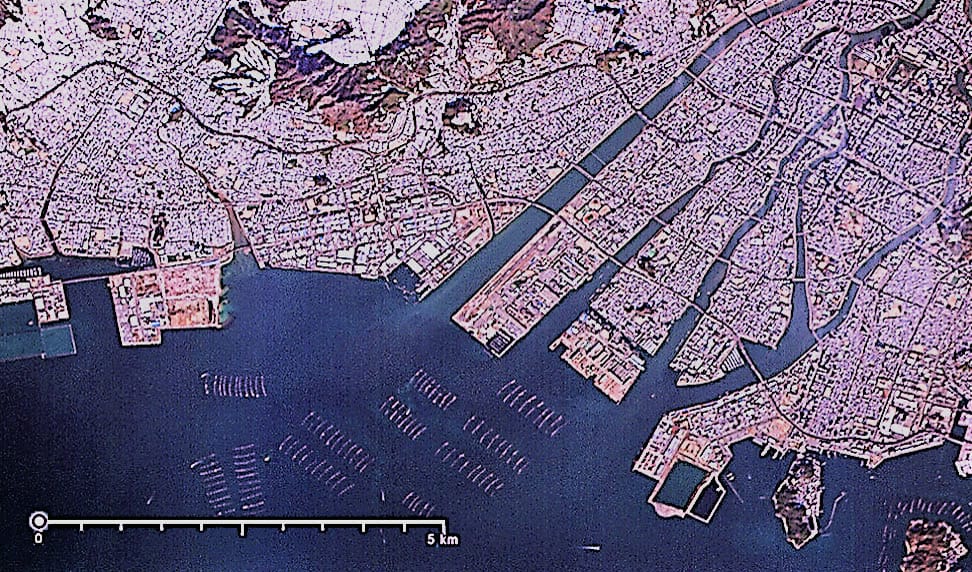
Most of Japan's oysters come from one prefecture. In 2023 Hiroshima produced 16,129 metric tons of shucked oysters, 62.9% of the national total.1 They grow on rafts in the calm, island-sheltered waters of the Seto Inland Sea, hanging from ropes beneath the surface. In winter the place to eat them is a kaki-goya, an oyster hut.
What an Oyster Hut Is
A kaki-goya is a simple, seasonal restaurant where you grill oysters in their shells over charcoal at your own table. Hiroshima's official tourism guide describes two kinds. Some are all-you-can-eat with a time limit. Others are ordinary shops where you order and stay as long as you like. At all-you-can-eat huts you may have to order by the kilo, which is about 10 to 12 oysters in the shell, and there is often a small charge for the charcoal. The huts are seasonal. The first one the guide lists, at Ujina, opens from around October to May, and another opens around November.2
The guide lists huts in the city and along the coast, including in Ujina, Kusatsu, Higashihiroshima and Hatsukaichi, the town facing Miyajima island.2

When to Go
Go between November and March, ideally in the middle of winter. That lines up with what the science says about Japanese Pacific oysters. In a study of oysters from Miyagi and Miyazaki, sampled from November to March, glycogen, the reserve that makes oysters plump and sweet, was highest in February.3 The biology is in oyster seasons explained.
What to Order
Hiroshima is a place to eat oysters cooked. Grilled in the shell at the huts is the obvious start. Around the city you will also find them breaded and fried as kaki furai and cooked into rice and hotpots. Raw oysters are available too, but grilled and fried are the local signatures.
Cooking changes an oyster's taste chemistry. In one study of Pacific oysters, steaming cut their measured umami strength noticeably, which is one reason cooked oysters taste rounder and less intense than raw ones. The figures are in the Champagne pairing article.
- Hiroshima City Agriculture, Forestry and Fisheries Promotion Center. 「広島かきの生産量等」 (Hiroshima oyster production statistics, 2023). haff.city.hiroshima.jp
- Dive! Hiroshima (Hiroshima Prefecture official tourism guide). "Oyster hut debut! Try Hiroshima's oyster hut!" dive-hiroshima.com
- Futagawa, K., Yoshie-Stark, Y. & Ogushi, M. (2011). Monthly variation of biochemical composition of Pacific oysters Crassostrea gigas from two main cultivation areas in Japan. Fisheries Science, 77, 687–696. doi.org/10.1007/s12562-011-0364-5