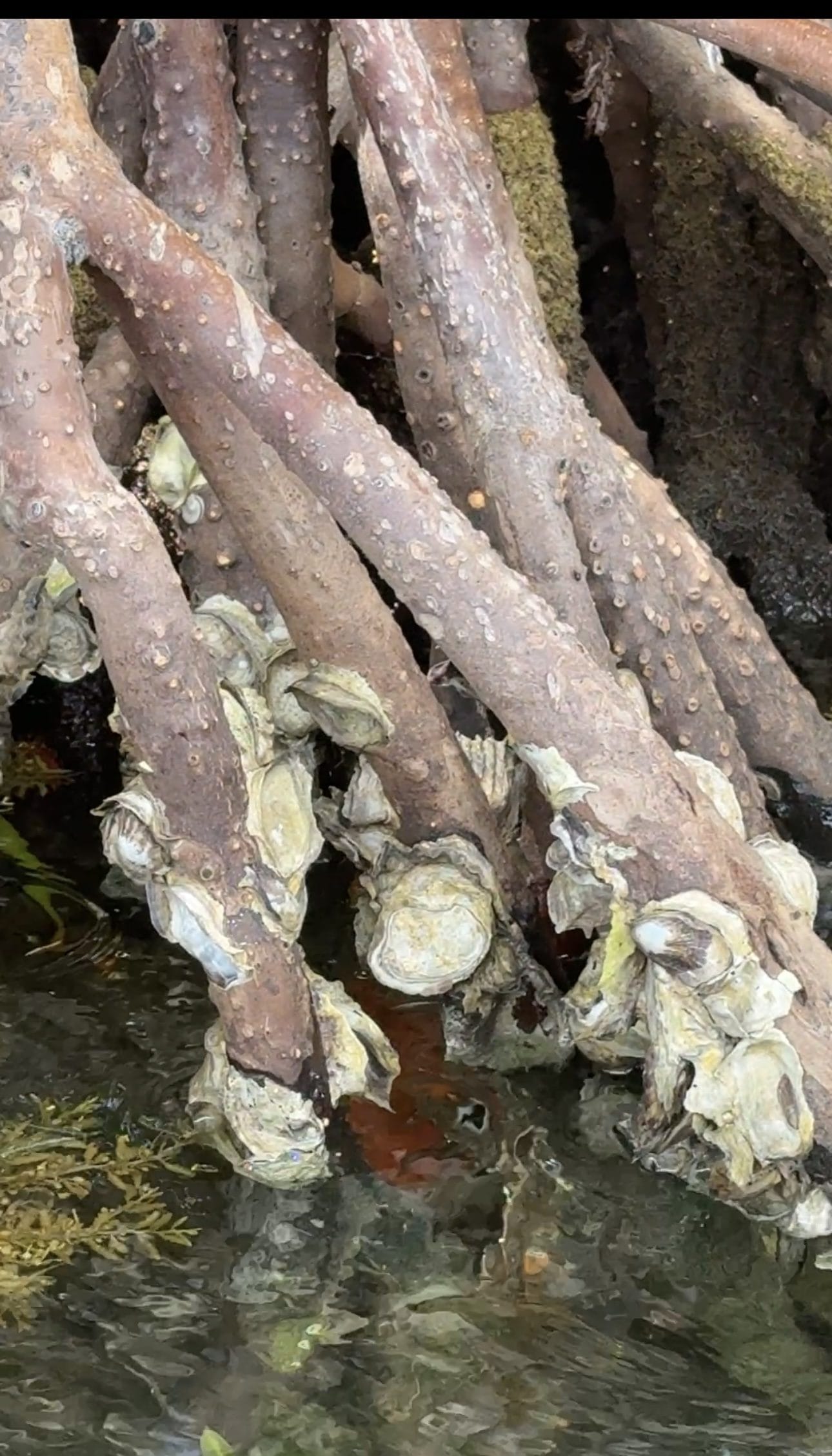
Crassostrea rhizophorae grows on red mangrove roots from the Caribbean to Brazil. It is fished in Cuba and Puerto Rico and farmed in Cuba and Jamaica.
Brine4/ 5
Sweetness1/ 5
Minerality4/ 5
Umami3/ 5
Caribbean / South America · Crassostrea rhizophorae · finish briny · texture lean · lemon yes · 15–25 ppt · 26–29 °C · best December to March
Basic Profile
Origin
Caribbean and Atlantic coasts of Central and South America, including Cuba, Venezuela and Brazil
Species
Crassostrea rhizophorae (mangrove cupped oyster)
Classification
Wild and farmed
Farming Method
Wild on mangrove roots; farmed in Cuba and Jamaica
Producer
Fishers and farmers across the region
Visual Signature
Small, 4–7 cm, deeply cupped
The mangrove oyster, Crassostrea rhizophorae, lives on the aerial roots of the red mangrove, in the narrow band between the tides, across the Caribbean and the Atlantic coasts of Central and South America. Adults are small, usually 4 to 7 cm.1
Mangrove oysters (Crassostrea rhizophorae) on mangrove roots, Puerto Rico. Photo: Paolanicoleroman / Wikimedia (CC BY-SA 4.0)
Fished and Farmed
It is fished commercially in Cuba and Puerto Rico and farmed in Cuba and Jamaica, where culture began at Bowden, with experiments in Venezuela.2 Wikipedia puts the harvest as high as 5,600 metric tons in the early 2000s.1 Because it filters so much water, scientists also use it to monitor coastal pollution.1
Flavor Breakdown
What's known
We found no published tasting study. It is small and grows in warm, mixed fresh and salt water, so expect a small, soft oyster.
How to eat it
In the Caribbean it is often eaten raw with lime and hot sauce, or in cocktails.
What Makes Mangrove Oyster Unique
Few oysters grow on trees. The mangrove oyster hangs from red mangrove roots, uncovered at low tide, which is how it got both its common and scientific names.1
A small oyster that grows on mangrove roots across the Caribbean. Eat it where it grows, with lime, from a seller you trust.
Should You Add Lemon?
Yes
Lime, as it's served locally.
Pairing Guide
1
Cold Caribbean lager
For a roadside cup of oysters.
2
Rum punch
Local and sweet against lime and heat.
Optimal
Lime and hot sauce
Acceptable
Cocktail sauce
Avoid
Nothing
Who Is This For?
Will love it
Travelers in the Caribbean
Anyone curious about tropical oysters
Should skip it
Anyone who only eats oysters from certified waters
We use one analytics tool — Google Analytics — to understand how this site is
used. It loads only if you accept. Essential cookies that keep the site working
are always on.Google Analytics loads only if you accept. Essential cookies are always on.
Read our Cookie Policy.