Basic Profile
The Kumamoto looks like a small Pacific oyster, but it is a separate species, Crassostrea sikamea, native to southern Japan and southern China. Its natural habitat is the upper intertidal zone, and it tolerates harsher conditions than the Pacific oyster.1 Farmed on the US West Coast, it has become one of the most recognizable oysters on American menus.
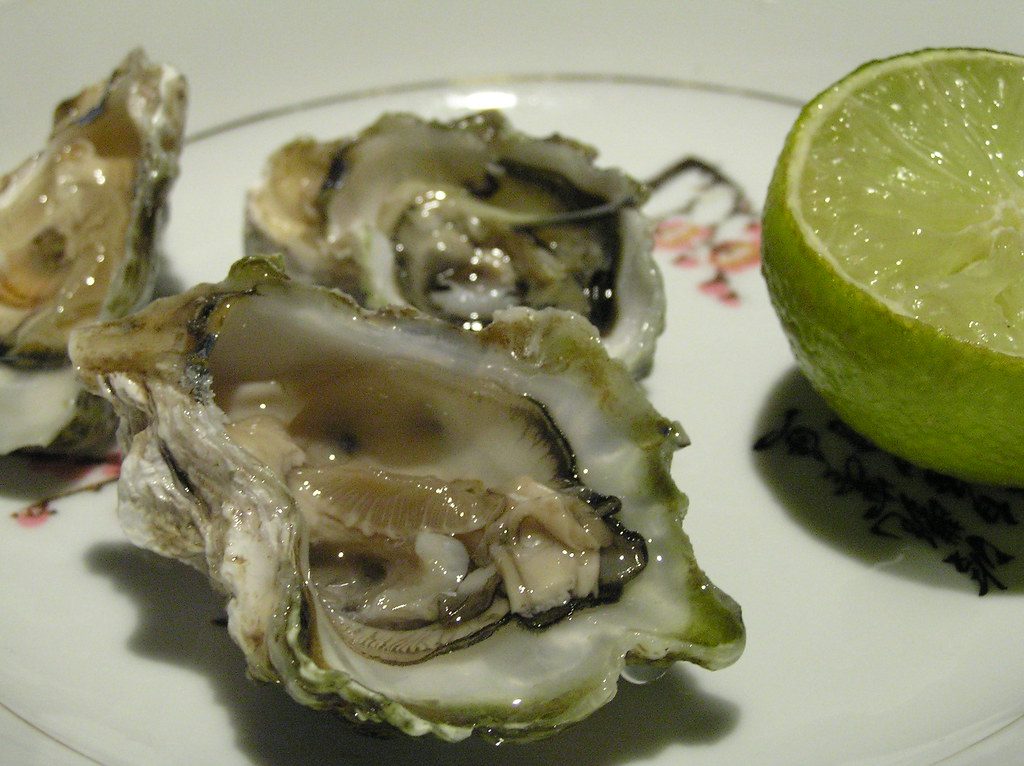
From the Ariake Sea to the West Coast
The Kumamoto came to the United States from Japan's Ariake Sea in the 1940s.1 It arrived partly by accident, mixed into post-war shipments of Pacific oyster seed, and was introduced commercially on the West Coast in 1947.2 Genetic studies treat it as a species of its own, and wild Japanese populations keep strong barriers to crossing with the Pacific oyster.3
It is often said that the Kumamoto has disappeared from Japan. A 2008 genetic survey of wild oysters in the northern Ariake Sea found the opposite: Kumamotos made up 91% of the 628 oysters typed, with no evidence of hybrids, and the authors concluded it was "neither rare nor threatened by hybridization" there.3 In 2006, oysters collected from the Ariake Sea were used to start a new breeding population for US growers, after some commercial stocks had become inbred or mixed with Pacific oysters.4 Its home water is covered under the Ariake Sea.
Small and Slow
Taylor Shellfish, one of its main growers, sells the Kumamoto at roughly 1 to 2 inches and says it takes about three to five years to reach that size, far slower than most oysters.5 On California's Humboldt Bay, Kumamotos brought in 62% of oyster revenue in 2016, far more than the bay's Pacific oysters.6 The bay's surprising economics are on the Humboldt Bay page.
Flavor Breakdown
What Makes Kumamoto Unique
The Kumamoto is a different species that happens to look like a small Pacific oyster. It takes three to five years to reach one or two inches,5 and it stores more glycogen than the oysters it has been compared with, which is the likeliest reason it tastes sweet.78
Should You Add Lemon?
Sweetness is the point of a Kumamoto, and acid covers it.
Pairing Guide
Fine bubbles and acidity for a small, sweet oyster.
Delicate and lightly chilled, a nod to the oyster's origin.
A crisp Sauvignon Blanc for a platter.
| Optimal | Plain |
| Acceptable | A drop of mignonette or ponzu |
| Avoid | Lemon, hot sauce, cocktail sauce |
Who Is This For?
- First-time oyster eaters
- Anyone who finds big, briny oysters too much
- Brine seekers and lovers of large, meaty oysters
- Liu, S., Liu, Y., Guo, X., Itoh, N., Chang, G., Lin, Z. & Xue, Q. (2025). Genome of Kumamoto oyster Crassostrea sikamea provides insights into bivalve evolution and environmental adaptation. Evolutionary Applications. doi.org/10.1111/eva.70100
- "Kumamoto oyster." en.wikipedia.org
- Camara, M.D., Davis, J.P., Sekino, M., Hedgecock, D., Li, G., Langdon, C.J. & Evans, S. (2008). The Kumamoto oyster Crassostrea sikamea is neither rare nor threatened by hybridization in the northern Ariake Sea, Japan. Journal of Shellfish Research. Summary at ars.usda.gov
- World Aquaculture Society (2025). "Development of a new Kumamoto oyster breeding population based on individuals collected from the Ariake Sea, Japan, in 2006." was.org
- Taylor Shellfish Farms. "Kumamoto Oysters." taylorshellfishfarms.com
- California Sea Grant. "Study: Bivalve business is big for Humboldt Bay." caseagrant.ucsd.edu
- Liu, S., Xu, H., Jian, S., Xue, Q. & Lin, Z. (2021). Molecular basis of taste and micronutrient content in Kumamoto oysters (Crassostrea sikamea) and Portuguese oysters (Crassostrea angulata) from Xiangshan Bay. Frontiers in Physiology, 12, 713736. doi.org/10.3389/fphys.2021.713736
- Tan, Y., Shi, C., Li, Q., Xu, H. & Liu, S. (2025). Regulatory variants of glycogen synthase contribute to differential glycogen content between Crassostrea gigas and C. sikamea. Comparative Biochemistry and Physiology B, 279, 111101. doi.org/10.1016/j.cbpb.2025.111101