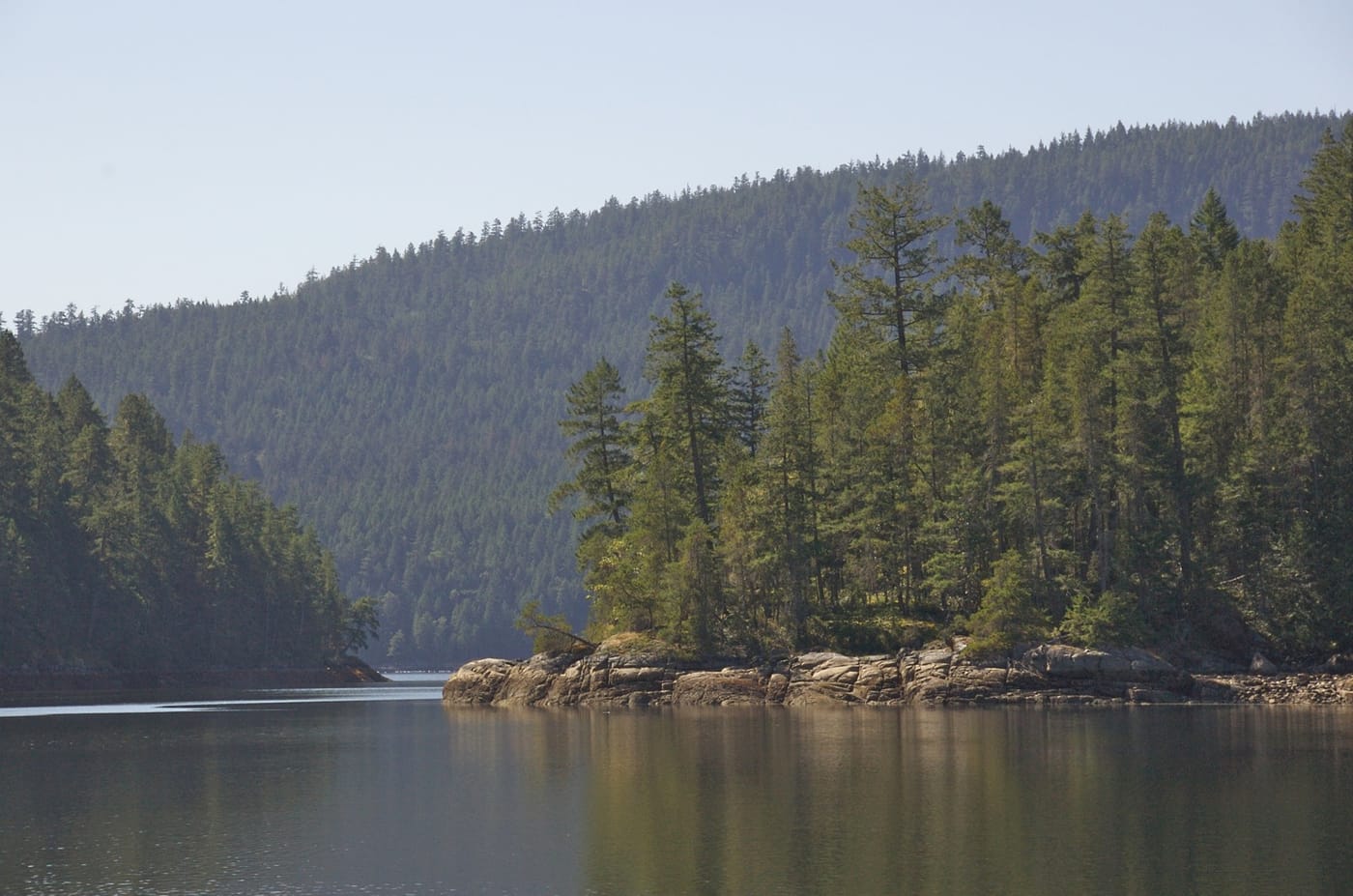
Formal oyster farming began in British Columbia's Okeover Inlet around 1955. About two dozen leases now work its beaches and floats, near Powell River.
Brine3/ 5
Sweetness3/ 5
Minerality4/ 5
Umami3/ 5
Canada · Crassostrea gigas · finish mineral · texture firm · lemon yes · 22–27 ppt · 6–15 °C · best October to April
Basic Profile
Origin
Okeover Inlet, off Malaspina Inlet, north of Powell River, British Columbia, Canada
Species
Crassostrea gigas (Pacific Oyster)
Classification
Farmed; about two dozen leases
Farming Method
Beach leases seeded with spat; long lines and trays suspended from floats
Producer
Okeover Inlet leaseholders
Visual Signature
Pacific oyster shell
Formal oyster farming began in Okeover Inlet around 1955. There are now about two dozen leases, which give a living to dozens of men and women.1
Grace Harbour on Malaspina Inlet, the channel that leads into Okeover Inlet, British Columbia. Photo: A.Davey / Wikimedia Commons (CC BY 2.0)
Beach and Float
The inlet is farmed two ways. Beach leases are seeded with millions of tiny spat and worked at low tide. In deeper water, oysters hang on long lines or sit in trays suspended from floats, held in place by grids of line and anchor. Clams, mussels and scallops are farmed here as well.1
Three or four times each spring and summer, farmers and volunteers form a work crew for Cleanup Day and clear debris from Okeover, Malaspina and Lancelot inlets.1 The seed that started the industry came from just up the coast, as told in the Desolation Sound profile.
Flavor Breakdown
Beach-grown
Oysters that dry out at low tide build a hard shell and a strong muscle. They are chewier and keep better out of water.
Tray-grown
Always submerged and always feeding, so they grow faster and come out softer. Our scores for the inlet put minerality highest.
What Makes Okeover Inlet Unique
Okeover is a working inlet, not a brand. Two dozen leaseholders share it, and the same growers who farm the inlet also clear its debris.1
A firm BC Pacific from a narrow, sheltered inlet. Ask whether yours grew on the beach or in a tray; the texture differs more than the taste.
We use one analytics tool — Google Analytics — to understand how this site is
used. It loads only if you accept. Essential cookies that keep the site working
are always on.Google Analytics loads only if you accept. Essential cookies are always on.
Read our Cookie Policy.