Basic Profile
Ostrea denselamellosa, called beotgul in Korean, is a flat oyster of the subtidal mudflats off Korea's south and south-west coasts, and is also found in China and Japan, where it was first described.12
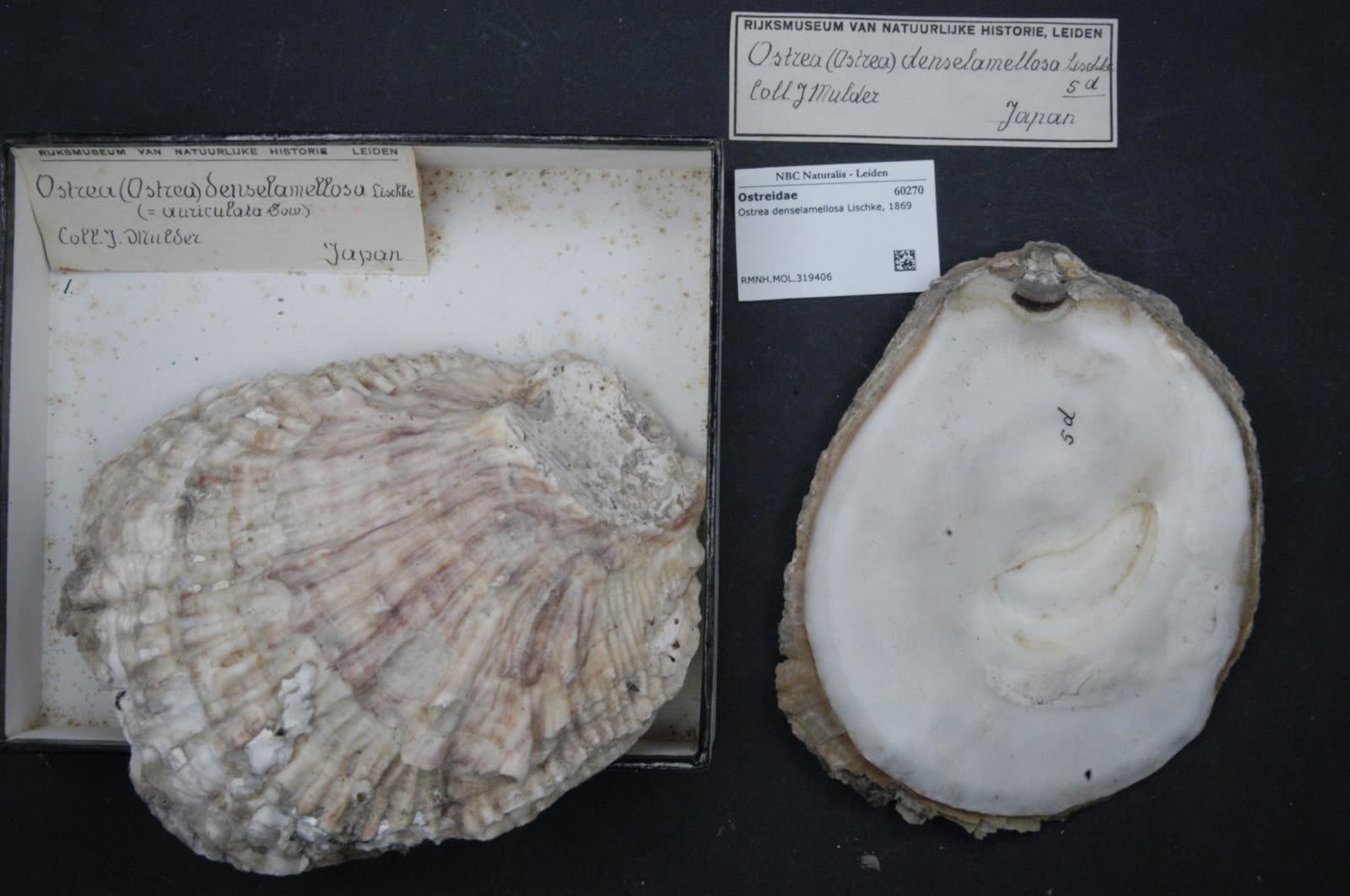

A Species in Decline
It is a live-bearing flat oyster, brooding its young, and its natural populations have declined sharply.3 In Korea it spawns from May, when the water reaches about 16.7 °C, until September.1 In 2026 researchers reported Bonamia ostreae, the parasite that devastated Europe's flat oysters, in wild beotgul from Korea's west coast, probably a recent introduction through the movement of oysters.2 The European story is in the diseases that redrew the oyster map.
Flavor Breakdown
What Makes Ostrea denselamellosa Unique
The beotgul is East Asia's counterpart to the European flat oyster: a brooding species in decline, now facing the same parasite that nearly wiped out Europe's flats.23
Should You Add Lemon?
Try one plain first.
Pairing Guide
The Korean table's drink.
Dry and savory.
| Optimal | Plain |
| Acceptable | Chogochujang |
| Avoid | Cocktail sauce |
Who Is This For?
- Flat oyster collectors
- Travelers in Korea
- Anyone looking for a widely available oyster
- Han, J. et al. (2022). Reproductive characteristics of the flat oyster Ostrea denselamellosa (Bivalvia, Ostreidae) found on the southern coast of South Korea. Journal of Marine Science and Engineering 10: 1326. doi.org/10.3390/jmse10091326
- Kim, S.H. et al. (2026). First report of Bonamia ostreae in wild flat oysters (Ostrea denselamellosa) from the west coast of Korea. Journal of Invertebrate Pathology. pubmed.ncbi.nlm.nih.gov
- Dong, Z. et al. (2023). A chromosome-level genome assembly of Ostrea denselamellosa provides initial insights into its evolution. Genomics. doi.org/10.1016/j.ygeno.2023.110582