Basic Profile
For most of the twentieth century, the portugaise was one of Europe's great oysters, and much of it came from two estuaries: the Tagus at Lisbon and the Sado at Setúbal. Pollution and disease almost wiped it out in the 1970s. The wild oyster beds of the Sado survived, and genetic studies now treat them as the reference population of the Portuguese oyster in Europe, with the least mixing with the Pacific oyster.1
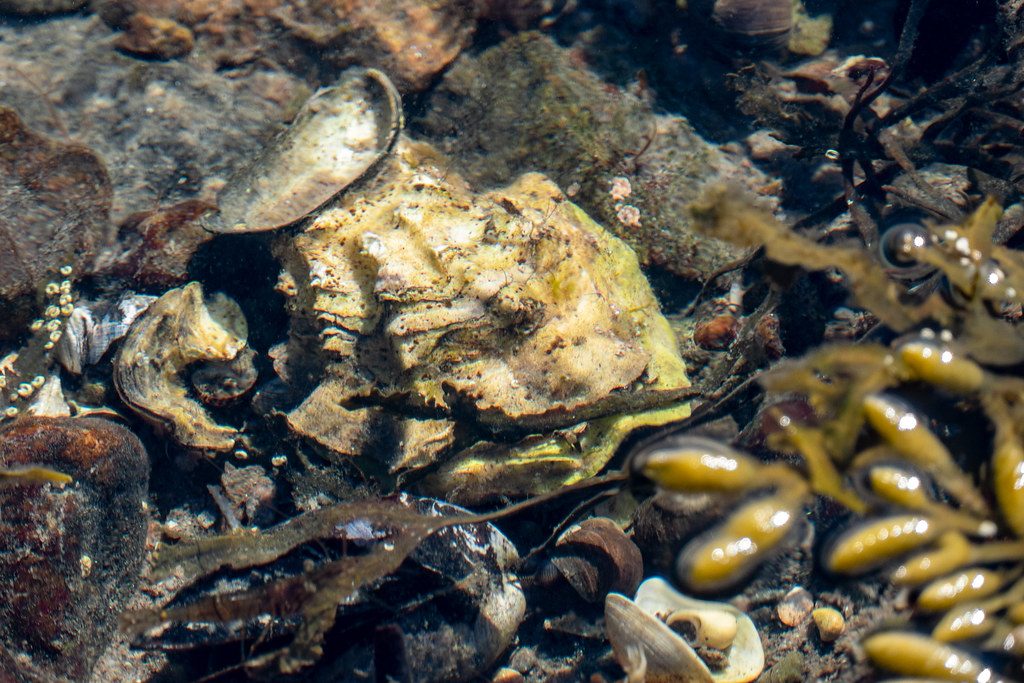
A Species With a Strange History
The Portuguese oyster, Crassostrea angulata, is not native to Portugal. It is a close sister species of the Pacific oyster, and the consensus is that Portuguese merchants carried it to Europe by accident in the sixteenth century, probably from Taiwan. By the end of the nineteenth century it had been introduced to France for farming, and it went on to replace the native flat oyster in several countries.1
Portugal's own estuaries were the source. Between 1953 and 1973 the Tagus and Sado held the largest natural Portuguese oyster beds, and their oysters went mainly to France. In 1954 about 80% of the productive area was in the Tagus, with the Sado growing in importance after that.2 At its 1960s peak, Portuguese production reached around 9,000 metric tons a year.3 The French side of the story is in Hemingway's portugaises.
The Collapse
From the 1970s the beds almost vanished. Researchers give two causes. Heavy industry grew along the Lisbon and Setúbal waterfronts and degraded the estuaries. At the same time a gill disease, later linked to an iridovirus, killed Portuguese oysters across Europe. An industry that had employed more than 5,000 people, mostly in the Sado and Tagus, declined.1 By 2013 Portugal produced 995 metric tons of oysters, about a tenth of its 1960s output.3 France's response is told in how France replaced the species.
Why the Sado Matters Now
A 2021 genetic study sampled oysters from seven natural beds along the Sado's salinity gradient and from seven farms. It found no Pacific oysters in the natural beds, and high genetic diversity despite the population's past bottlenecks. The authors link this to a local ban on introducing farmed Pacific oysters into the estuary, a protection the Ria Formosa and the Ria de Aveiro did not have. In the Ria Formosa, where Pacific oysters have been farmed, the Portuguese oyster shows more genetic mixing with them.1
The same study found Pacific oysters occasionally turning up in local hatcheries, and warned that this puts the reference population at risk.1 Setúbal's farms have grown both species. A 2016 report described Sado growers raising Pacific oysters from seed flown in from France,3 and national figures for 2016 recorded 241 metric tons of farmed Portuguese oysters against 633 metric tons of Pacific oysters.2 If you want the angulata, ask which species you are being served.
Flavor Breakdown
What Makes Setúbal (Sado) Unique
The Sado's wild beds hold the least mixed Portuguese oysters left in Europe: a 2021 study found no Pacific oysters in seven natural beds, which the authors credit to a local ban on introducing farmed Pacifics.1 The species once supplied France by the ton, collapsed in the 1970s, and survives here as the reference population for science.12
Should You Add Lemon?
Try one plain first.
Pairing Guide
Light, prickly and Portuguese.
Lisbon's own sharp white.
| Optimal | Plain |
| Acceptable | Lemon |
| Avoid | Heavy cocktail sauce |
Who Is This For?
- Anyone curious about the Portuguese oyster
- Visitors to Setúbal and the Arrábida coast
- Anyone who won't ask which species is on the plate
- Chiesa, S., Lucentini, L., Chainho, P., et al. (2021). One in a Million: Genetic Diversity and Conservation of the Reference Crassostrea angulata Population in Europe from the Sado Estuary (Portugal). Life, 11(11), 1173. doi.org/10.3390/life11111173
- Selo de Mar. "Ostras, um fruto de Setúbal," summarizing Almeida, J.A.P. (2019), Ostras, um fruto de Setúbal. Valorização gastronómica e cultura alimentar do Sado, MA thesis, Universidade de Coimbra. selodemar.com; estudogeral.uc.pt
- Observador (March 5, 2016). "As ostras chegaram de caravela e agora regressaram ao Sado de avião." observador.pt